 I have been thinking a great deal recently about a question which seems increasingly important as home education changes: Who is actually in control of a home-educated child's education? I don't mean who pays for it, or who teaches the lessons. I mean who decides what this particular child needs to learn, when he needs to learn it, how it should be taught, and what matters most at this stage of his education? Is it the parent? Or, increasingly, is it the community, the tutor, the curriculum provider or the group leader? When home education becomes something else There is nothing wrong with families meeting together. There is nothing wrong with using a tutor when a child has a genuine need that the parent cannot meet. There is nothing wrong with learning from other people. The question is what happens when these things begin to determine the education rather than simply support it. A family may begin by joining a group for friendship and an occasional activity. Then the group has a curriculum. Then there are books that everyone is expected to buy. Then there are lessons, homework and expectations. Then there are particular age groups and particular standards. Before long, the family may still call itself home educating, but much of the child's education is being determined elsewhere. And because the people running the group are presented as experts, parents can begin to assume that they must know better than they do. I have heard this repeatedly from parents I interact with around the country. Some have told me they have felt obliged to buy the group's books even when money was tight. Others have accepted classes or work that did not seem appropriate for their particular child because they felt they needed to keep up with the group. One mother needed reassurance from me before she felt able to tell a community tutor that the history essays being set were inappropriate for her son. That stopped me in my tracks. Why did she need somebody else to give her permission to make a decision about what was appropriate for her own child? Before we decide how to educate, we need to know why Perhaps this is the question underneath all of this. Why are we educating our children the way we are? If we haven't really thought about that, it is very easy for somebody else to answer the question for us.
Christian parents need convictions about education.
Those convictions don't mean that we can never use a tutor or attend a community. They should simply mean that we are able to look at what is being offered and decide whether it actually fits what we believe our child needs. We should be using the community to support our educational convictions, rather than allowing the community to supply them. The problem may begin with the parent I don't think parents who become dependent upon groups or tutors are foolish. In fact, I think there is a much deeper reason for what is happening. Many parents today had a poor education themselves. They may never have been taught what a good education looks like. They may not know how to teach reading, spelling, mathematics or writing. They may feel completely out of their depth when they are suddenly responsible for educating their own children. So when somebody comes along saying: "We are the experts. This is what your child should be learning. These are the books. These are the classes," it can be enormously reassuring to hand over the decision-making. The parent may not consciously feel that she has handed over control. She may simply feel that she has finally found someone who knows what they are doing. I think this is why specialist help needs to be handled carefully. I am about to take on another family from a community because their child has a genuine problem with reading, which his mother has not been able to solve herself. That is not a contradiction. The mother has recognised that there is a problem and that she needs specialist knowledge. I can provide that knowledge and teach her what needs to be done. The question is what happens next. Does the specialist help the parent become more capable? Or does the parent become increasingly dependent upon the specialist? Good help should increase capability rather than replace responsibility. The same applies to the child I think the same principle applies to the child. One of the things I value about the Robinson Curriculum model of education is that self-study is not simply "Here are your books. Get on with it." The child is taught the foundations. He is taught how to study. He is helped and supervised. Then responsibility is gradually transferred to him, while accountability remains. The goal is an increasingly independent learner. That is a very different educational aim from keeping a child dependent upon adults to organise, explain, prompt and manage every part of his learning. And this is one reason I am increasingly concerned about the amount of time some home-educated children spend in organised activities and lessons. It isn't necessarily that those activities are bad. It is that time is finite. Children need sustained daily practice in reading, writing and mathematics; two whole days spent attending community lessons may have consequences even when every individual lesson sounds worthwhile. The question remains: Who decided that this was the best use of this child's time? If the answer is always, "That's what the community is doing," then the family is no longer making the educational decision. Home education should not mean simply "school somewhere else" Perhaps this is the distinction I am trying to work out. There is a difference between: Home education with community support and home education directed by a community. In the first, the parent remains responsible. The parent decides what the child needs. The family chooses what help is useful. The community provides friendship, resources or occasional specialist experiences. In the second, the community gradually becomes the authority. It decides what children should learn, what books they should use, what classes they should attend and what standards they should meet. The parent is still physically present, but the educational authority has moved elsewhere. That can begin to look very much like school by another route. Don't outsource the thinking Perhaps this is the principle I keep coming back to: Don't outsource the thinking. Home education does not require a parent to know everything. It does require the parent to remain willing to ask: What does my child need? Why does he need it? Why now? Who can help me if I don't know how to provide it? And perhaps most importantly: Am I becoming more capable of educating my child, or am I becoming more dependent upon people who tell me how to do it? That, to me, is the heart of home education. It isn't that everything has to happen inside the four walls of the home. It isn't that parents can never use tutors. It isn't that families should never meet together. It is that the family remains responsible for the education. The parent thinks. The parent decides. The parent takes responsibility. And the child is gradually trained to take responsibility too. I am still thinking this through myself. Home education has changed enormously since the days when some of the older home educators I know first began, and I suspect some of those changes deserve more thought than we have given them. But I keep coming back to this: Before we decide what to put into our children's education, perhaps we need to know why we are educating them in the first place. And once we know that, we may find that we don't need to do nearly as much as we thought — but what we do choose to do needs to matter.
0 Comments
Are We Teaching Children to Love God's World — or Escape From It? "Finally, brethren, whatsoever things are true, whatsoever things are honest, whatsoever things are just, whatsoever things are pure, whatsoever things are lovely, whatsoever things are of good report... think on these things." Philippians 4:8 This verse has long been the guiding principle behind my approach to home education. It reminds me that education is not simply about filling a child's mind with information. It is about shaping the heart, forming affections, and teaching children what is worthy of their attention, admiration and love. As Christian parents, we spend many years teaching our children to love what is good. We teach honesty because dishonesty comes naturally. We teach kindness because selfishness comes naturally. We teach self-control because our desires do not naturally govern themselves. Scripture tells us that the heart is the centre of who we are: "Keep thy heart with all diligence; for out of it are the issues of life." (Proverbs 4:23) This raises an important question: What are we teaching our children to delight in? God's world as a classroom When we look at the wisdom of Solomon, we find something very interesting. The Bible tells us: "And he spake of trees, from the cedar tree that is in Lebanon even unto the hyssop that springeth out of the wall: he spake also of beasts, and of fowl, and of creeping things, and of fishes." (1 Kings 4:33) Solomon's wisdom was not separated from the world God had made. He observed creation and drew lessons from it. The book of Proverbs is filled with these lessons:
Our Lord Jesus Himself taught in this way. He pointed people to lilies, birds, seeds, sheep and vineyards. He used ordinary things from everyday life to reveal spiritual truths. Creation is not dull. Creation is God's handiwork. Yet I sometimes wonder whether modern childhood has become increasingly disconnected from this source of wisdom. Many children today can identify fictional creatures more easily than the birds in their garden or the trees in their neighbourhood. They know imaginary worlds in great detail, yet often know very little about the astonishing world God has actually made. The power of imagination There is, of course, a wonderful place for imagination in childhood. Children are designed to imagine. A cardboard box can become a boat. A chair can become a bus. This kind of imaginative play is a wonderful part of childhood. But I believe we need to recognise that not all imagination moves in the same direction. There is a difference between imagination that enlarges the real world and imagination that replaces it. A child playing with figures as farmers, builders, explorers or families is imagining possibilities within the world God has created. But what happens when the imagination becomes centred on hidden powers, magical abilities and unseen forces within ordinary things? This is a question I began to think about through my own experience as a parent. A personal reflection As a child, I read Rupert Bear without giving it much thought. To me, it was simply a children's story. I found it rather boring and never thought much more about it. Years later, when I read some of the same stories to my own five-year-old son, I saw something I had never noticed before. He saw the magic. His play began to change. Like all children, he enjoyed imaginative play. Toys became characters. Objects became part of stories. This in itself was perfectly normal. But gradually, I noticed that his imagination was becoming increasingly fascinated with the idea of hidden magical powers. Ordinary objects were no longer simply part of pretend play; they seemed to possess secret possibilities. It made me stop and think. Perhaps another child would have responded differently. I can only speak of what I observed in my own child. But it caused me to ask a question I had never seriously considered before: What is this story teaching my child to delight in? The issue was not that imagination itself was wrong. The issue was the direction that imagination was taking. Good and evil — but what captures the heart? Scripture gives us a very different starting point from the modern assumption that children are naturally good and only need freedom to express themselves. The Bible tells us, "Foolishness is bound in the heart of a child" (Proverbs 22:15). This does not mean that children are without beauty, wonder or preciousness; rather, it reminds us that the heart needs careful nurturing and direction. Children do not naturally grow towards wisdom and holiness without guidance. They must be taught to love what is good. One of the difficulties we face today is that we often judge stories only by their obvious moral message. A story contains a battle between good and evil. The hero is courageous. The villain is defeated. Sacrifice is honoured. Therefore, we conclude that the story must be good. Of course, these things are valuable. We want children to admire courage, loyalty and selflessness. But children do not experience stories merely as moral lessons. They enter into worlds. They are drawn towards what is exciting, mysterious and beautiful. A child may understand that evil is wrong, yet still be fascinated by the very things that make evil appear exciting. They may know the lesson while their imagination is being shaped by something else. This is why I believe Christian parents need to ask a deeper question. Not only: "What lesson does this story teach?" but: "What does this story teach my child to love?" The heart is not shaped only by ideas. It is shaped by what we repeatedly admire, enjoy and desire. Choosing what fills the imagination This is why I find myself increasingly drawn towards stories grounded in reality.
These stories do not lack wonder. The real world is already full of wonder because it is God's world. A child watching a caterpillar become a butterfly is witnessing something astonishing. A child learning about a missionary who sacrificed comfort to serve others is seeing courage greater than fiction. A child studying the lives of faithful men and women is learning that real people, by God's grace, can do difficult and wonderful things. Perhaps one of the greatest gifts we can give our children is not an escape into other worlds, but eyes to see the wonder in this one. A final thought Philippians 4:8 does not merely tell us to think about what is correct. It tells us to think on what is true, honest, just, pure, lovely and of good report. These are not only ideas. They are things we learn to love. As Christian parents and educators, our task is not simply to fill children's minds. It is to cultivate hearts that delight in what God delights in. And when we remember that God's creation, God's Word and God's work in the lives of His people are already overflowing with beauty and wonder, we can be confident that we do not need to look elsewhere to find something worthy of a child's imagination.  Help your child learn about nature with a subscription to Nature Explorer - age 3 to 10!  A word to young mothers No sooner than you have had your first child, you find yourself entering the 'rat race'. You notice it at playgroup, at the park, in the WhatsApp groups. Someone mentions their child walked at nine months. Another says seven. A third adds that her child was speaking in sentences by eighteen months. Before you know it, you're going through your own child's milestones in your head, wondering if you should mention the early reading, the vocabulary, the thing the health visitor said. Or worse, you say nothing, feeling inadequate because your child was just ordinary. Normal. Or worse still, you don't say it out loud — you suspect they may have special needs. Later, the race intensifies — and the questions come crowding in: Am I using the best home-ed curriculum? Will my child stay ahead, or do I need to switch to one that a friend says is working with their children? What about this resource, or that one? Will my child be affected if I don't use it? Parents in the race can be pulled from one direction to the other and lose sight of what is right for their child. It's exhausting. And it's everywhere. It can puff you with pride or leave you low in the gutter. Name it for what it is This is comparing, but with more energy: it is now competition. It is seeking self-affirmation and identity through your children's performance. It might feel modern and accepted behaviour (after all, it is what everyone is doing) — social media, milestone apps, the "gifted and talented" obsession — but it's an old sin in new clothes: pride. And we are all affected by it. Proverbs 16:5 warns that "everyone that is proud in heart is an abomination to the LORD." Pride, like its author, the devil, is subtle and can lurk in unsuspected corners of our hearts. What is wrong with it? It makes your child's worth depend on performance — and teaches them that love and approval have to be earned. That's the complete opposite of the gospel: we cannot earn God's love, or wipe away our sin by our own efforts. Ephesians 2:8-9 — "For by grace are ye saved through faith; and that not of yourselves: it is the gift of God: Not of works, lest any man should boast." Titus 3:5 — "Not by works of righteousness which we have done, but according to his mercy he saved us, by the washing of regeneration, and renewing of the Holy Ghost." It makes your worth depend on your child's performance — which is idolatry. You're seeking from your child what you should be getting from God: affirmation, identity, proof that you matter. Jeremiah 2:13 — "For my people have committed two evils; they have forsaken me the fountain of living waters, and hewed them out cisterns, broken cisterns, that can hold no water." It breeds pride or despair — if your child is ahead, you're proud. If they're behind, you're ashamed. Neither honour God or help your child. It teaches your child pride. When you praise their achievements to others, when you broadcast their milestones for approval, they learn to do the same. Your pride breeds pride in them. It kills fellowship — you can't rejoice with other mothers or carry their burdens if you're secretly competing with them. Why is it worse now? The worldview of the age says:
You have to remember as well that we all come with our own strengths and weaknesses. Some cope easily with things that would overwhelm others. Some have endless energy and resilience. I was not in either of those categories. I have had to painfully learn to accept who I am and not wish I had a different character — 'then I could be like so-and-so'. When you learn to be content with yourself, you can minister to others — not driven to be something you're not, not trying to keep up, just content with who the Lord has made you and what He has given you. To be sure, this can be a battle. How to correct it in yourself Repent of seeking identity from your child. Your worth before God doesn't change whether your child walks at 9 months or 15, reads at 3 or 7, gets into Oxford, or never goes to university. God's love for you is based on Christ, not on how your children turn out. Colossians 3:3-4 — "For ye are dead, and your life is hid with Christ in God. When Christ, who is our life, shall appear, then shall ye also appear with him in glory." Ephesians 1:6 — "To the praise of the glory of his grace, wherein he hath made us accepted in the beloved." Pray and ask the Lord to help you: Refuse to compare. When the conversation turns to milestones, you don't have to join in. You don't have to one-up anyone or defend yourself. You can smile and change the subject. If you want to say something, just say, "Every child is different." Celebrate ordinary. If your child is ordinary — and most are — that's good. Ordinary children grow into ordinary adults who can live faithful, quiet, God-honouring lives. Ordinary is not failure. Focus on training your child's character, rather than on abilities. Check what you're putting on social media. If you post every milestone, every achievement, every clever thing your child says, ask yourself why — search your heart for that pride. Are you genuinely sharing joy, or hoping for affirmation? Maybe the very act makes you feel better. Recognise it. Are you encouraging other mothers, or quietly competing? Spend more time with your child than looking for opportunities to post. Remember what you're raising them for. You are not raising a high-achiever. You're raising a child to live in obedience to God and not be conformed to this world. You do want them to be the best they can — not to be better than others, but as an act of worship. 1 Corinthians 10:31 — "Whether therefore ye eat, or drink, or whatsoever ye do, do all to the glory of God." Romans 12:2 — "And be not conformed to this world: but be ye transformed by the renewing of your mind, that ye may prove what is that good, and acceptable, and perfect, will of God." Children copy what we do more than they listen to what we say. You do not have to play the game This isn't easy. You are tired, you are isolated, and the culture around you measures and compares constantly. But you don't have to join in. You can step out. You can consciously choose to be the mother who listens well, celebrates other people's children without envy, and rests in the knowledge that God sees your faithfulness even when no one else does. The Christian should make choices about everything and anything, totally free of the thoughts of others, solely looking to live in obedience to the Lord. First, ensure that your understanding of God is right. Without a correct theology, you will fight a losing battle. Then, prayerfully work out with your husband what is best for your family and your children. This will include if, when and what you post on social media — if anything. Then walk in that path and do not deviate without good cause. Always run ideas through your husband first. This will stop impulses. 1 Thessalonians 5:21 — "Prove all things; hold fast that which is good." Your child does not need to be exceptional to bring God glory. Neither do you. God delights in humble, quiet obedience.  The Embedded Worldview in Contemporary Worship SongsA post for those who feel uneasy but don't know why Many home-educating families I speak with are already living by a particular conviction: that what surrounds our children forms them. We choose books carefully. We think about what voices come into our homes, what values are carried by the stories we read, the programmes we watch, the use of the internet and the culture we inhabit. We understand, often instinctively, that the formation of our children's minds and characters is not just about what is explicitly taught. It happens through atmosphere, through repetition, through what is treated as normal. Most of us apply this thinking carefully to almost every area of life except one. When it comes to the music sung in Sunday worship, a different assumption tends to take over — that the words are what matter, and the music is simply a vehicle. Change the words, the argument goes, and you have changed the message. This post is for those who have sat in a Reformed church, heard a worship 'song' (I deliberately use the word 'song' rather than 'hymn'), felt something was not quite right, and lacked the language to say why. That unease is not because you lack musical ability. It is, I want to suggest, a sound theological instinct. And it has a long history behind it. Music Has a Voice of Its Own Despite what we are often told, music is never neutral. Every musical style carries what we might call an embedded worldview — a set of values, things is is associated with and emotional assumptions that communicate independently of any words placed over them. For example, a funeral march communicates grief before a single word is sung. A lullaby communicates gentleness. A military march communicates discipline and advance. We know this instinctively, and no change of words alters it. Music has its own message. Plato believed that music itself — not the words, but the actual sound — shaped people's character. He thought certain types of music should be banned in a well-ordered society because they formed the wrong kind of person. He wasn't being old-fashioned. He understood that music does something to you, whether you notice it or not. 'Musical training is a more potent instrument than any other, because rhythm and harmony find their way into the inward places of the soul.' (2.) And he wasn't alone in thinking that. It's been the view of serious thinkers throughout history. The modern idea that music is neutral — that a tune is just a tune with no effect on you — is actually the new, odd opinion. Not the old one. What Calvin Understood John Calvin wrote about this in 1543, in his preface to the Genevan Psalter (2). He wrote: "Care must always be taken that the song be neither light nor frivolous; but that it have weight and majesty... there is a great difference between the music which one makes to entertain men at table and in their houses, and the Psalms which are sung in the Church in the presence of God and his angels." Calvin wasn't just stating a personal preference. He was giving a theological principle: that music used for the worship of God must itself be appropriate to that act. The music of the world and the music of the sanctuary are completely different things — not in quality or skill, but in purpose and association. They serve different masters. He went further, stating that melody in worship should be "moderated in a manner to carry gravity and majesty befitting the subject." The music is not a passive container. It preaches. And it must therefore preach truthfully. This principle — that what is appropriate in the home or for civic occasions is not automatically appropriate in worship — is not a relic of the sixteenth century. It is the logic that should govern every decision about worship music today. And it is biblical. In the Old Testament, instruments that were used for civic occasions were different from those allowed in the temple. God made the distinction, not man. Rock and Roll's Embedded Worldview Rock and roll did not emerge as a neutral musical form waiting to be filled with better content. It emerged from a specific cultural moment in 1950s America, carrying a specific set of values: youth rebellion against authority and tradition, emotional and physical liberation as ends in themselves, the primacy of individual feeling over inherited truth, and the present moment over the permanent. These are not incidental features of the style. They are woven into its rhythmic structure, its performance conventions, its entire cultural meaning. The theologian and music scholar David Cloud, writing from within conservative evangelical circles, has noted that the rock backbeat and its associated performance culture do not become neutral simply because Christian words are placed over them. The form itself communicates, and what it communicates is at odds with what Reformed worship is intended to do. Therefore, we have to ask whether a musical form built on the rejection of authority, tradition, and objective truth is a fitting vehicle for the worship of the God who is absolute truth — and for the formation of children in that truth. But Where Does the Bible Say the Beat Is Wrong? This is the question a friend put to me recently, and it is exactly the right question to ask — because it deserves a proper answer rather than a vague appeal to feeling. The Bible does not say the beat is wrong. Drums are not wrong in and of themselves. The Psalms themselves call for timbrel and dancing and clashing cymbals. A march has a strong, driving beat. A hymn has a rhythmic pulse. The argument is more specific than that. It is about which beat, carrying which cultural meaning, arriving from which context. Or put it another way - what is the purpose/meaning of the beat? The particular rhythmic signature of rock and roll — the backbeat, with its heavy emphasis on beats two and four rather than the steady one and three of a march or a hymn — did not arrive as a neutral musical option waiting to be used for good purposes. If you are used to listening to rock music, you may not have recognised the pattern of the beats. Tune your ear to hear it. Practice beating time to a march and then try making beats two and four stronger than beats one and three. We call this the 'off-beat'. Hear for yourself the effect. It arrived in the late 1950s and early 1960s as the rhythmic 'badge' of a specific cultural revolution. The snare cracking on the offbeat was the sound of rebellion. It was heard that way by the young people who loved it and by the older generation who were alarmed by it. Both groups were responding to something real. What happened in the 1960s was not simply a change of musical taste. It was a generation deliberately throwing off Christian moral restraint — deferred gratification, submission to authority, the body governed by conscience. The beat was central to that rejection. Physically, it bypassed rational engagement and spoke directly to the impulse of the body. That was the meaning of the beat: freedom from restraint, expressed in the rhythm before a single lyric was written. This is not simply my opinion. Those who wrote this music in those days made it clear that this was their intention. The beat of rock and roll was the beat of a worldview — and that worldview was the direct opposite of what the Reformed faith confesses. The Bible may not mention the backbeat by name, but it speaks clearly about not being conformed to the pattern of this world (Romans 12:2), about bringing the body under discipline rather than following its impulses (1 Corinthians 9:27), and about the surrounding culture's values being a genuine danger to spiritual formation — not merely its explicit sins but its whole way of seeing and feeling. So the question is not whether drums appear in the Bible. The question is whether a specific rhythmic form whose entire cultural meaning is the rejection of the restraint God calls us to can be used in worship without bringing that meaning with it. A steady march beat and a rock backbeat are not the same thing, wearing different clothes. They carry different histories, different associations, and different formative effects — and those differences do not disappear when the words above them change. The Getty Question This is where many Reformed Christians feel the argument does not quite apply to them, because the music they are considering is not rock in any obvious sense. Keith and Kristyn Getty are widely respected, seemingly theologically serious, and state clearly that they are committed to the recovery of congregational singing. Their songs — In Christ Alone (co-written with Stuart Townend), Speak O Lord, By Faith, Holy Spirit Living Breath of God, O Church Arise — are sung in Reformed churches across the English-speaking world, and their lyrics are considered genuinely doctrinally rich. Words aside, as they are not the subject of this post, the music deserves the same scrutiny we would apply to anything else we bring into the formation of our families and congregations. The Getty sound draws heavily on folk music, but it is the folk music of the commercial Celtic revival of the 1990s — the world of Riverdance, Celtic Woman, and the broader packaging of Irish and Scottish folk culture as a marketable global genre. This is quite different from what Ralph Vaughan Williams was doing when he arranged English folk tunes for congregational use in the early twentieth century. Vaughan Williams was drawing on genuinely pre-industrial, pre-commercial communal music — melodies that had developed organically over centuries, with no entertainment industry behind them. The emotional weight they carry is the weight of genuine folk memory. The Celtic textures in Getty productions arrive tainted with commercialism. The uilleann pipes and fiddle arrangements carry the emotional associations of the pop concert stage, not the village or the field. This gives their music what some listeners describe as a slightly staged quality — polished, professional, but not quite rooted. The words say one thing; the sonic world gestures toward another. And the visual staging reinforces it — blue lighting, darkened rooms, production techniques borrowed straight from secular entertainment. Stuart Townend's case is interesting: Townend has spoken openly about the Beatles as a formative musical influence, and in his own live performances, his songs are delivered with a full rock band — drums, electric guitar, bass — in a way that is quite different from the stripped acoustic arrangements used in most churches. In Christ Alone, co-written by Townend and Getty, has a melody designed for mass singing and lyrics of considerable theological drama. In full performance, it is a driven, powerful piece. The version most congregations sing (as with all contemporary songs) is a practical simplification — but one that also hides the rock 'energy' the composer heard in his head when writing it. Although they say that they write for the family and the congregation, their 'hymns' are written to be performed in settings as far removed from the traditional Reformed church as possible. That alone should speak volumes. This matters because the way a composer performs their own work reveals their original intention. The stripped church version is an adaptation. The full performance is what the author had in his mind as he wrote it. The Formation Problem The most serious concern, however, is not about any single song or artist. It is about long-term effects. What a congregation sings week after week, year after year, shapes what they believe and how they relate to God — not only through the words but through the entire musical act. The Heidelblog, a Reformed theological resource, has noted that much contemporary worship music functions primarily to produce what one writer calls "a mild euphoria" — and that this euphoria is frequently mistaken for a genuine encounter with God. If the music consistently mimics the feel of the entertainment world — the concert hall/pop stadium experience, the swell of production, the staged performance — then the congregation is being affected by those things, whether they notice it or not. Children, especially, are formed by what is treated as normal in worship. If the Sunday service feels like a concert, they will learn to expect and seek that feeling when they think of meeting with God. Many go so far as to think that is the only way to encounter God, and go seeking after such experiences. And even if the song is played by a little old lady on a rusty piano, the associations are still there - and amplified in people's heads, having listened to them performed by the artists at home. Without doubt, sooner or later, someone will want to replicate that experience in the church and in will come the drums and guitars. Tension builds, some hold out, church splits occur, and the music has served its purpose - it has fused the church with the world. This is precisely the concern that drives home-educating families in every other area of life. We already understand that music shapes the message. Calvin understood it in 1543. Plato understood it long before that. The church does not need to reinvent this wheel. It needs to apply a principle it already holds in theory to the practice of Sunday worship. A Word for Those Who Feel It But Cannot Name It If you have sat in a church service and felt that something in the music was not quite fitting — not the words, but the music itself — you are not being awkward or unspiritual. You are not failing to appreciate sincerely meant worship. You are responding to something real. Music is not neutral. It has always preached its own sermon alongside the words it carries. The Reformed tradition has always known this, even when it has not always applied the knowledge consistently. The question is not whether the words alone of a contemporary song are biblical or not. That is important, but not for this post. The question is whether the music they are set to carries an embedded worldview consistent with what worship is for — and whether the congregations singing those songs on Sunday morning have ever been invited to ask that question. Most have not. This post is an invitation to begin. If you have never done so, I invite you to listen to a 'song' you may sing in your church, thinking it is a 'reformed' hymn, performed as it was written to be. Compare it to the hymn below, which has stood the test of time and proved beneficial to countless Christians through the ages, set to a tune that does not compete with the words, keeping the words central. Then take the tune away from the first. What is left? Do the same for the hymn. What is left? Which one still carries its message without the music?
Textural references:
References and further reading:
 Tracing the Ancient Roots of Modern Rebellion |




Here the index finger is too far over, forcing the thumb sideways into a cramped position. This position tends to cause the child to press too hard on the paper.
|

I call this 'death by thumb grip'.
The thumb is gripping round the pencil. This does not facilitate the fine control needed for well formed handwriting. |

Here, the thumb and index finger are more or less correct, but the pencil is sitting too high up the middle finger for good support.
|


The correct position. Called the 'tripod' position as the three fingers are centred around the tip of the pencil, the middle finger providing a 'chair' for the pencil and the thumb and index finger merely holding it in place. Note that the thumb and index finger do not touch each other.
|


Children with low muscle tone
Tips: Give the child a fat tool until sufficient muscle tone has been developed to hold a finer tool.
Felt-tip pens are best as they give a strong mark with the least pressure.
Do not expect the same level of neatness as for a child without low muscle tone; however, never settle for less than the child's best and strive to help the child to reach the highest standard they can attain. Never excuse a child because of his/her disability, but be understanding of his/her limitations.
  |
  |
Teach correct letter formation from the beginning
First check that you are forming your letters correctly, so that you provide the right role model.
How to form letters correctly
It is helpful, but not essential, if children are taught to form letters as they learn the initial sounds of the letters. The act of writing helps to link the sound and symbol in the child's mind.
Right from the start introduce a line for the letters to sit on. This is important as it establishes the relation of one letter to another so that letters can be written in proportion to each other. It also helps the child's work to look neat and tidy and avoid line confusion, which is common when children start to write without lines to write on.
As you teach each letter, talk through it's direction.
E.g. 'See it starts at the top, comes down to the line and up and over (h).
Or: We start at the side and go round to touch the line at the bottom and back to close the circle and down to the line for the stick. (a)
Tell the child that all letters start at the top, never at the bottom.
I use one line for young children, but age 5/6 onwards I do some formal work in a proper handwriting book with 4 lines to help them 'see' and 'feel' how letters are proportioned.
These free handwriting tracing sheets may be of help:
www.soundfoundations.co.uk/product/handwriting-tracing-sheets/
|
|
Practice makes perfect
Use paper and pens for pre-schoolers as pens make a good solid mark on the page, whereas achieving the right firmness with a pencil is hard for young children. Move to a pencil as soon as possible. Big fat pencils are easier to hold for 4/5 year olds.
  |
  |
  |


  |
Younger children do best with wide lines to write on. You can draw your own (just a few) on a piece of paper. Initially use very wide lines as their writing tends to be large. As they gain more control and their letters get smaller, this book is ideal.
(approx age 5/6) |
Stages in learning to write
Very young children may want to try and 'pretend' write and this should be encouraged. Children may continue to 'pretend' write once they obtain some writing skills, with a desire to practice their new skills and having the effect of making them feel like writers. Again, this is good. Sadly, for some children, this 'pretend' writing is left to 'emerge' into proper writing, with minimal guidance from an adult. With this I disagree. There must be formal times of teaching, of letter formation, spelling and subsequently, grammar, form and style. The two approaches need to be kept in balance, but with the aim of the formal teaching underpinning the 'pretend' writing, until the child's skills are such that the two merge together.
Once a child can form many letters correctly, and can write his/her name in the correct case (capital to start each name and the other letters in lower case), then my approach is to have the child give me a short sentence, maybe to write under a picture. I then write on the top line, with capital letters in the correct places and proper punctuation, and then ask the child to copy under my writing. This gives a standard and a model to work to. This is a good way to start copy work as you can regulate the size of writing. Copying from a book with small print and funny looking letters (e.g. 'a') can be off-putting when you are just starting to learn. Young children have little control of the pencil, so write clearly and fairly large - letters at least 2 cm tall. Reduce the size of the writing as they progress.
With regular practice it also introduces the children to common words like 'the' and 'here' which some will easily pick up and learn to spell for themselves. It teaches them to leave spaces between words - but you will need to encourage them to use a finger to leave a space between their words as they copy to begin with.
When s/he has finished, look at how s/he has copied. Get used to assessing your child's work - don't just accept what you are given. Are the letters correctly formed? Are they sitting in the right place relative to the line? Give feedback to the child and pick out just 2 or 3 letters to practice, or one word to write again, giving guidance as to how his/her handwriting can be improved. Obviously, praise for good effort. Never praise for carelessness, though.
When handwriting is fairly controlled, and the child can cope with funny looking letters (like 'a'), find good quality books (with language you wish your child to emulate) for your child to begin copy work, starting with a short sentence a day. Read it to the child if it is beyond his/her reading ability, or let him/her read the words s/he can read. Once more, assess the work on completion and give teaching tips. The child should have accurately copied everything - no capital letters in the wrong place, properly punctuated, check the letter formation etc...
As children copy in this way, they will absorb spelling, grammar and sentence construction. You will be surprised how delighted they will be to find words they can read. 'Oh look, it says ....!' they will be thrilled with their page of REAL writing. Children know when they are not writing properly. We are naturally delighted with their attempts when they are 3/4 years old, but if they are still writing in play writing aged 7/8 (unless there is a reason for this) then you will have a frustrated child on your hands who if they haven't already, will soon give up on writing and declare they can't do it!
Once children have sufficient spelling skills then they can be asked to write more and more by themselves, but never overwhelm them. If you feel your child is retracting into thinking they can't write, back off and let him/her copy again until confidence returns.
 
Once a child's handwriting becomes more controlled, s/he can move to a standard pencil. These are durable - the best we have found.
|
 
This is a smaller size note book with normal width ruling - ideal once the child is writing fluently, but it doesn't overwhelm with an enormous blank page.
|
Age 10 plus
Once a child reaches ten, then more formal writing instruction can be given - the mechanics of actually putting a piece of writing together, sentence by sentence, to communicate a message in the best possible way.
Parents differ in how they approach this: whether to use a writing scheme at this point, to let the child choose it's own topic, or to give a topic, or a mixture of all three. What is important is daily writing practice. As someone once said, you learn to write by writing, just as reading comes with reading etc..
My children wrote heaps by themselves in informal ways before the age of ten, but writing for school work was set by me and was done to my standard. At the end of each writing session, you need to give feedback as to grammar, punctuation, spelling and style - the sound of the writing. It is with this feedback that many parents feel they need help. There are various writing programmes available to home-educators. Two of the most popular are:
Writing With skill
https://welltrainedmind.com/p/the-complete-writer-writing-with-skill-level-1-student-workbook/
  |
  |
  |
  |
Institute for Excellence in Writing
In order to succeed in every area of life, children must hone the skills needed to communicate confidently and effectively. Through the process of learning to write well, students learn how to think clearly and to express themselves eloquently and persuasively. Our goal is to equip you to assist your child in this process.
All ages
 
Handwriting pens for 'best work'.
|
 
A super smooth fountain pen
|
Schools will often colour-band their reading books to make it easier for a child to choose an appropriate book. This is not foolproof, however, and should not be relied upon. It also has the down-side of encouraging children to think they are better, or worse readers, depending how far up the banding scale they are. It may also make them think that the book levels are all there is to reading and set their aspirations too low. This, too, can be unhelpful.
How do we decide a book is right?
The beauty of home-schooling is that you can go at a pace suited to your child without needing to compare him/her to ‘levels’ which are artificial. Without the pressure to meet a particular ‘level’, children are freed from the stigma of failure.
What is more important is that your child is comfortable reading the books s/he reads. If a child cannot read many of the words, or understand what is being read, then the child will not enjoy reading. It will become a chore. Speed is not the aim, nor is competing. For this I am so thankful as it takes all pressure off of me the teacher. Our world is all about competition. As Christians we can side-step that. Our aim is doing all things ‘as unto the Lord’.
So I would rephrase that question.
What can your child read?
Good books, even if they were primarily written for younger children, will teach much. There is nothing wrong with an older child still enjoying books for younger children. By a good book, I mean one that demonstrates good grammar and style of literacy. This is important because as a child reads, they are not only taking in the story, but also learning grammar and writing style at the same time. These are your tools for teaching writing that many teachers neglect. They are also the means by which children learn to grapple with difficult ideas - books help to teach children to think. Do not underestimate the power of reading.
What is most important is:
a) that your child reads.
Ten minutes times school grade per day is a good goal. Keep the reading time short to start with – ten minutes if need be - and gradually build up.
Help your child to choose a book. Children will often err on the side of what we consider too easy. Be happy with that to start with and resist the temptation to say "Oh that's too young for you." Look at the text and decide if it is within your child's ability to read it. Then set a quiet time when reading can take place without distractions.
This is a good discipline: it helps to build reading stamina and also children start learning that reading is expected by you. Bear in mind that it is mainly through reading that all other subjects will be learnt.
Always talk about what your child has read with him/her afterwards – a bit of special mom time always goes down well!
The modern books for children do not contain good examples of grammar or writing style. They may pass the world's standards, but in the past they would have been considered of a very poor standard.
My advice is to choose reading material from pre 1960's.
You can find suitable books for all ages on our reading list.
The older the book the more value it will have for your child with a richer vocabulary and better grammar. There are a few exceptions to the rule, either way. Some like Michael Morpurgo, but I'm afraid I class his work as very shallow in comparison with for example G. A. Henty. Do not forget non fiction books which all count as well.
You will also want to guide your child towards reading longer, more demanding books as his/her ability to sustain concentration develops.
Here again, modern books fail us not only as they tend to be light reads, not requiring depth of thought.
For those anxious about their child being able reach GCSE standard- be reassured. The standard is not high. If your child is used to reading demanding texts by age 16 then there will not be a problem.
Remember too, that as children age, they should ideally move away from purely fictitious works which often feature increasingly immoral content, as well as encouraging a delight in entertainment to titivate the senses. Historical fiction, for example, or historical biographies are far better as these titles are based around real events, teaching history as well, though as history is not a fool proof subject, care must be taken here too.
‘This reader (or book) is a handbook for developing the power of reading for comprehension and habits of study. (It) leads a child, through appropriate work at each stage, to grow in comprehension of the meaning of words, sentences, and paragraphs, with corresponding power to pick out information, to arrange facts in order of their importance, to make useful summaries of what has been read, to frame questions and to prepare answers, to arrange matter so that it may be remembered easily and quickly and in general to use printed and written material as the skillful student will use it. All this practice will bear fruit not only in his reading of literature, but more particularly in his study of textbooks in history, geography or science. By teaching him(her) reading in this broader sense we place in his (her) hands a powerful implement for gaining knowledge as apart from mere information.’
Doesn’t this just lift reading to a higher level straight away. We are not getting our children to read books to prove their prowess or otherwise in reading. Along with the writing which encourages them to further organise their thoughts and frame arguments etc... we are putting into their hands powerful learning tools to equip them for life.
Believe me, even if your child never reaches higher level books, his/her work with any books of a high caliber will teach study skills for life. Many of us have seen that happen in our children.
As you grow in confidence at choosing books with your child and see the results it will get easier. I know it seems a huge jump to abandon the ‘security’ of knowing what level a child is on, but that’s not true learning! Enjoy learning.
To find many, many, more, please see:
www.christianhomeeducation.weebly.com

Memory Verse
When thou passest through the waters,
I will be with thee;
and through the rivers,
they shall not overflow thee:
when thou walkest through the fire,
thou shalt not be burned;
neither shall the flame kindle upon thee.
Isaiah 43:2
This verse is a promise to those who trust in the Lord Jesus that he will look after us in life and in death. Very tiny children can learn the words in bold and understand that it is the Lord who is speaking to his children. The words are all simple; only “kindle” may require some explanation to little children. I have set out the words so that you can learn them in various ways depending on how many children are working together. Two children can repeat the verse, with one saying the green and the other the orange words, joining together for the last line. Three children can say a pair of lines each, joining together for the last line. If you swap over, every child will have learned the
whole verse. If a child is working alone an adult can partner with them using the green and orange words and swapping over. Memory verses such as this can be practised at all sorts of times such as in the car or even while doing chores.
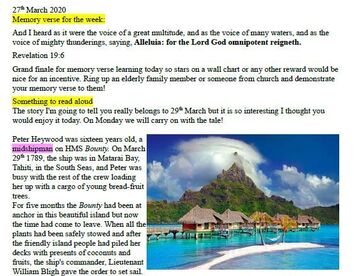
Something to read from history
For three hours after the night attack got going, I shivered in a sandbag crow's-nest atop a tall building near the Thames. It was one of the many fire-observation posts. There was an old gun barrel mounted above a round table marked off like a compass. A stick of incendiaries bounced off roof-tops about three miles away. The observer took a sight on a point where the first one fell, swung his gun-sight along the line of the bombs and took another reading at the end of the line of fire. Then he picked up his telephone and shouted above the half gale that was blowing up there, “Stick of incendiaries – 190 and 220 – about three mile away”.
Five minutes later a German bomber came boring down the river. We could see his exhaust trail like a pale ribbon stretched straight across the sky. Half a mile downstream there were two eruptions and then a third closer together. The first two looked as though some giant had thrown a huge basket of flaming golden oranges high in the air. The third was just a balloon of fire enclosed in black smoke above the house-tops. The observer didn't bother with his gun sight and indicator for that one. Just reached for his night glasses took one quick look, picked up his telephone, and said, “Two high explosives and one oil bomb”, and named the street where they had fallen.
There was peace and quiet inside for twenty minutes. Then a shower of incendiaries came down in the far distance. They didn't fall in a line. It looked like flashes from an electric train on a wet night, only the engineer (2) was drunk and driving his train in circles through the streets.
Half-an-hour later a string of fire bombs fell right beside the Thames. Their white glare was reflected in the black, lazy water near the banks and faded out in midstream where the moon
cut a golden swathe broken only by the arches of famous bridges. We could see little men shovelling those fire bombs into the river. One burned for a few minutes like a beacon right in the middle of a bridge. Finally those white flames all went out. No one bothers about the white light, it's only when it turns yellow that a real fire has started.
(1) Adapted from Owen, Evan, What Happened Today Volume 2, available on the Mothers' Companion Flashdrive: https://motherscompanion.weebly.com.
(2) American term for an engine driver.
Helping younger ones understand
Those who were too old or not fit to go did fire watching work (as above) and helped to take care of families. If you have any old photos of grandparents as children or of great grandparents this would be a good time to get them out and have a look. Learning the memory verse helps us understand that God looks after his children.
Something to write
Take your notebook along and make notes about everything you can. Now take your notes and work them into a paragraph that is as vivid a description of the activity you have chosen as possible.
Think of someone who has never seen jam made or heard an orchestra or flown a kite and try to interest them in the subject.
If, when you have finished this exercise, you find you have enjoyed doing it, there may be ways of taking it further. Local newspapers are sometimes grateful for contributions, especially the free newspapers who have to provide interesting content if they are to attract the advertisers who provide their revenue. Look to see if your localnewspaper has a regular sports report – if sport interests you. If they do not already have a column then send in a report of a local match or competition and they may print it. Has your church held any special service such as a Sunday School prize giving or a harvest festival recently? Write something about it, being sure to give your
church's name and address and the times of services, explaining that everyone is welcome to come.
If your piece does not get published, don't give up. Keep trying and your writing will improveespecially if you ask as many people as you can to read it and make comments.
If you are a member of a local home education group you might be able to get together with friends and produce a little magazine of your own now and then. You could let any friends or family have a copy for the cost of paper and ink. If you like the idea, ask around; you may find you have friends who enjoy writing, drawing, making up crossword puzzles or taking photos who would be able to contribute.
The secret to writing a successful magazine is to choose your subject carefully as you will need to be able to have plenty of subjects for the articles to keep you going for a long time. Secondly, make sure that the magazine is full of good quality content; content written to inform and educate, not to impress. Avoid too much 'padding' with adverts, puzzles and large photos. Use these wisely but sparcely.
Make sure every page is full. Lastly, pay attention to creating a pleasing design, rather than a sensational one.
Something for younger ones to make
Something to read for older ones


Have you seen?

|
|
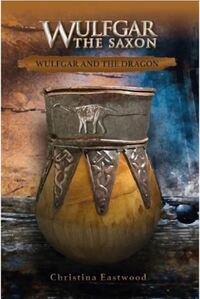
By Christina Eastwood
The result is a new website:
Christian Home Education
What are the lessons like?
- Each week starts with a memory verse to be learnt over the course of the week.
- Each day starts with a true story/ies of something/s that happened on that day in history. Having read the story together, families are encouraged to try several different activities based on the story and which can extend learning in Science, History, Geography and Art.
- All of the activities can be done in the home using every day items that you most probably already have.
- Biblical truths are taught as a matter of fact throughout the lessons. More importantly the lessons teach both parents and students how to devleop a biblical worldview. That is: how to view the world in accordance with what the Bible says about the world. This helps us to understand the spiritual warfare being waged throughout history and our present age. This wlll be the most important thing you ever teach your children.
Affordable and comprehensive
It is not a glossy curriculum, but that is a good thing as text books often turn children away from subjects making them 'dead'. These lessons, instead, will excite interest in history, geography and science, spurring further study and greater interest. Lessons will come alive. Learning will become natural.
Useful for home-education groups
Using the lessons with ages 3 to 7
We have endeavourd to make at least part of each days lesson suitable for the younger child. Please search through to find it (it is labelled). Sometimes, where appropriate, we have written a a part of the lesson again specially for younger children. These are by no means the only parts of the lessons so suitable, but you alone as parent know your child and can decide what is suitable. However, if you have young children, can I recommend that parents read the whole lesson for themselves, as you will then be developing your own biblical worldview which will enable you to teach more effectively as your child grows.
Indexed
You can see that here:
https://christianhomeeducation.weebly.com/lesson-directory.html
Something to think about
This leaves many parents confused: should they change the curriculum? Is it the wrong one?
In this post I will explore push-back from children when they are asked to do school work and we will look at practical things that you can do to remedy the situation. Most will find that once these things are considered and put in place, push back diminishes and the curriculum is no longer a problem.
Why do children push back?
The remedy, he says, is the home-school schedule/routine.
Most parents these days do not know how to respond when their children whine and complain when they are asked to do something they find unpleasant. As a result, the children find it easy to manipulate their parents.
The remedy is the home-school routine. Many parents think that the only solution is to pander/bribe the children and make school work fun. But Fred Lybrand - who has home-educated a large family of children - says that your home-school routine is the key. In other words, our home-school routine is very often the thing that is encouraging pushback. As, he says, it is not that we do not have a routine; it is an excellent one that encourages pushback. Therefore we need to tweak our routine so that it produces different results - the ones we desire; in this case, children who settle down to study and make good academic progress. This is encouraging: it means that we can control pushback by changing our routine.
So now let us turn our focus onto the home-school routine and how it can remedy pushback in our children.
The home-school routine
First, understand the seriousness of education
In and of itself, yes, this is true. They do not need to sit for 6 hours, doing busy work and can most often complete their school work in less time. However, when I hear parents say this, I usually find that the parent has taken it to mean that they can fill their children's day with outings and social events. These may be educational outings and home-school group events, which can seem good. However, this gives the children the, probably hidden, message: 'School work is not important.'
Understand how children learn: It is though daily repetition. It is one tiny new skill, practiced until it is mastered. This can be tedious. It takes time and effort on both the pupil's and the teacher's part. It needs the child's full concentration.
Let us be clear; we should not home-educate so that our children do not need to do so much work. We home-educate as Christians because we want better for our children; better than what they would receive in school. That means more quality work, and less timewasting so that more (not less) can be accomplished in less time. But none-the less the children need daily, quality time to study.
How do we set up our routine to provide daily, quality time study?
Set a time for schooling to start
Mornings are when our brains are, for the main part, at their most alert before the distractions of the day come upon us.
By all means have chores for your children to do before school starts.
Decide for how long each child should study
When you begin your new routine, you may need to find out how long a child reasonably needs to say, do a math lesson. Then give a set time. Once that time is up, the child moves on to the next subject. Any work not completed is then done out of hours, while others are doing other things. This gives an incentive to complete work on time and ensures that each subject has its allotted time. An open ended arrangement encourages the child to think that s/he can take all day.
Aim for a quiet working atmosphere in the home
My advice is to set mornings aside for working. You will want all children, including toddlers, to know that it is a time for being quiet. It is not a time for playing. I never used to allow play before school in fact, as it acted as a distraction. Our family got up, dressed, had breakfast, did chores and then school started. Decide what will work in your situation. Younger children can always quietly do craft, or other educational activities once their core work is done for the morning.
Never let young children go off and play noisily while others are trying to study. Keep any music practice until the afternoon and again to regular times. All children have a right to a quiet study environment to help them to do their best.
Free the home from distractions
- Telephones: either in-coming calls or parents using their devices.
Solution: Let your friends and family know that the answer phone will be on during school time. You may have to be politely firm with people who insist on ringing. The phone ringing and your answering will momentarily (and sometimes totally, if it ends up being a long/interesting call) break the thread of concentration and cause unnecessary errors, lack of thought and care and waste precious time.
Turn off your own devices during school time so that the children know that they have your 100 percent attention. If you are distracted, by calls or social media, they will use the opportunity to push back.
- Too many social activities
In addition, if a child needs more time to complete studies in the afternoon, and we take him/her out, then that opportunity to teach teach a child to work in a set period is lost.
Even more distracting are outings planned for the morning, which break up the working rhythm of the week - making it hard to get them back on track the next day, giving opportunity for more pushback. Too many engagements in the calendar can also overstimulate children and the home. They need all their mental capacity to study well - a quiet home environment with a regular routine.
It is good for children to be taught to be home-lovers. We go out of the home to minster and to worship the Lord, but we are homebased. We want to raise men who lead their families, rather than chasing their entertaining pursuits away from the home, and we want ladies who are home-makers, not spending many hours out of the home, either physically of virtually. We often forget that we are in the process of training our children's appetites for adulthood.
Solution: Select a few, well chosen social activities and consider very carefully when they take place. Aim to keep the home life calm. Avoid lots of out-of-home activities. Avoid mornings as far as is possible. Obviously there will be the odd all-day educational outing during term-time, but these do not need to happen every week. Once a term is good yard-stick.
- Noise
Although some adults work better with some noise, few children can, in my experience.
Solution:
I suggest that the home is kept quiet during the morning study period and that children work in as near to silence as can be achieved.
- Too much entertainment in the home
Although many argue that the use of technology for entertainment can help to stimulate children's brains, I find that actually it stops them from learning and creates a barrier that has to be overcome.
Computers make learning seem easy with fast paced pictures and a click of a button. They lie, as learning is far from easy and requires a lot of effort and concentration. Dr. Robinson of the Robinson Curriculum suggests that parents keep their children away from technological devices until they have completed their studies. That seems far fetched in our modern society - but it is not impossible and the benefits far outweigh any negatives.
Consider:
- They stop children from learning to think for themselves. This should be one of our main aims as Christian home-educators.
- They create a competitor to school studies, both vying for the child's attention. You can guess which one will win!
- They are highly addictive and as such are very dangerous for young, immature minds.
- They make studying look dull by comparison. Who wants to grapple with complicated maths when their mind is on something more exciting? If your child seems to be doing just fine while using technology out of school hours, consider how much more could be achieved by using that time more constructively.
- Not least, they promote worldliness.
Solution:
Severely limit the time children spend using technological devices. Better still do not let your children have access to them until they are nearly adults. Teach them to love reading, studying and using their minds creatively in a God-honouring way. Teach them to spend their time wisely.
- Tiredness
A late hour of retiring for parents leaves them tired and vulnerable the next day and easily battled down by irritable children.
Solution:
Have set bedtimes for all and stick to them. Get up at the same time each day. Set your alarm. Get the children out of bed, unless they are sick. This teaches good habits of self discipline and accountability for the way time is spent. Do not encourage laziness.
Keep entertainment - computers/TV out for the bedroom as they are, apart from anything else, destructive to good sleep patterns. Make sure all lights are off at the set time.
In conclusion
May the Lord bless your endeavours for him.

May we not say that teaching is essentially the response of the adult to the moral and intellectual need and readiness of the child?
The whole subject of teaching and training is one which cannot be looked upon as a thing by itself apart. Teaching and training are amongst the fundamental, if not absolutely and fundemental processes of world-building. And all that the world is by the inheritances and traditions of the past reacts upon those who are labouring to make it what they think it ought to be.
The whole past history of man is bound up thread by thread, fibre by fibre, with the present of every living individual. Because of this past, the teacher is what he is no less than the child and the nearer they come together in willing sympathy and cooperation, the more successful will all teaching be. (Emphasis mine)
The longer one teaches and observes the teaching of others the more does one become persuaded that there are spiritual forces in education which cannot be tabulated in a text-book. Subtle forces of personality, the direct influence of mind on mind and of character on character are ever at play.
The formalities of method are no substitute for a living touch with the truth we teach on the one hand and with the child to whom we teach it on the other.
The more we know of the nature and the growth of the mind and heart and conscience in the child, the better are we qualified to be his educators.
Children are not empty minds into which we pour 'education'. Neither are they only dependent on that which we pour in. Children are always learning - though what they learn may not always be helpful to them.
By the use of its natural powers of attention and retention the mind grows, even independently of the teachers efforts. At whatever stage the teacher's work commences there is a considerable amount of already developed mind to be reckoned with.
To be a good teacher:
- We cannot neglect to teach the heart and if we do so we will find that our education works against us, to our destruction.
The broader and richer the conscious the larger the mind. The fear of God should be the noblest exercise of the human mind, because the consciousness of God is our highest consciuousness, being that in which all truth, all law, and all beauty center and form a harmony.
Children desire praise: when it is deserved, give it to them; it will go further than sweets, or treats.
Children love society: give them yourself (note - he doesn't say lots of other chidlren!); be less their teacher and more their friend; or be more their teacher by being their friend. (A child needs its parents!)
Children desire to know: you are teaching them; banish your want of confidence when you have real food suited to the mental digestion of your child.
Children are imitative: it is not impossible to act as one would wish to see them act. (Children do what you do, not what you say - unless the two are the same!)
Children love power: the teacher is opening up the pathway to power by showing that our virtues are our strengths. and that wisdom's ways are ways of power as well as of pleasantness and of peace.
Children want to excel: no-one can better guage and take note of this desire in them than the teacher (and who is a better teacher than the parent).
Children love activity: their teacher can be their leader, suggesting or finding ways in which they can act well and helpfully.
We must address our teaching to the entire child before us, and not merely to a fractional part of it.
Study the Bible, know God, understand your task and study your pupil.
See also: Providing a good education in lockdown: heads, hearts and minds.
*All quotations from: The Teacher and the Child by H. Thiselton Mark: T. Fisher Unwin, London, 1902.

I think that it is fair to say, that for many people, the word education makes them think of school book work and particularly of 'school' and a curriculum - unless you were home-educated yourself! Maybe you have never stopped to think much about your child's education and what you would like it to achieve.
Maybe you have doubted your ability to provide a good education for your child at home. Maybe you think that school can impart knowledge that you do not have, or that your child will have better opportunities to develop social skills, or maybe even it will afford them opportunities that you cannot provide at home.
Maybe you have already been home-educating your children but wonder if it is enough. Those of you who are new to home-educating can sympathise, no doubt, with this thought - 'Can I really provide a good education for my child at home? Is it enough?'
This is a good question to think about.
I want us to consider another question though. Are we too ready to undervalue, or maybe not even recognise, the important education that only we as parents can provide - in the home? Maybe even as home-educators we think only of the 'curriculum' and do not consider what is called the 'hidden curriculum' - those things that are learnt from the home/school environment itself which can heavily influence how a child receives the seen 'curriculum'.
To help us to think about these things , we will first look a little more closely at what 'education' involves and then the education provided by the home.
What is education?
Heads, hands and hearts
Education is more than books and head knowledge, very worthy though this is. It needs to be balanced by the training of the hand and the heart if it is to be of use to the future man or woman.
How do we train a child?
Telling is helping to know.
Teaching is helping to know and grow.
Training is helping to know, grow and do.
So how does our home-education train - even if we normally send our children to school?
The education of the home
If you are home-educating due to the current lockdown, let me give you hope and inspiration: your child does not need to be stuck pouring over a book for good education - real education, to be taking place. Further still, your child is in the best place for being educated. A period at home could be amongst the richest months for your child's education. This is due to the fact that the home is the bedrock of all education and it cannot delegate its task to the school. The school can never replicate home, however much it tries.
Parents should never expect the school to make up for its deficiencies. The home, says Clarence Benson* is 'in itself strictly an educational institution'. It's just that very often we think that we send our children to school to be educated and we just take care of them in between times - not realising that the school cannot make up for our lack of education at home. And education will be provided at home, even without conscious effort on behalf of the parents - either for good or for bad. However I'm sure, that you, like me want the best for our children. In other words - if we have children, then we are 'home-educators' whether we send our children to school or not - it comes with the responsibility of being parents.
So let us look in more detail as to how we can provide a good home-education for our children during lock-down.
Training the head
Parents will teach their child to speak, sleep, eat, walk, count maybe, learn colours even, and more, and then are often willing to hand the child to a teacher feeling that they are not skilled enough to take the child further. Do you know - the best teachers are learners with their pupils? You do not need to know everything to be a teacher - only to have enough love for your child to want to encourage him/her to learn. Many parents testify to having learnt far more from educating their children than they themselves learnt at school.
The key qualification is not a degree, but love for your child. As the parent, you are perfectly qualified for the role of teacher - actually better qualified in some respects than the teachers!
Education is more than mere imparting information, it is stimulating a desire to learn for oneself. Note however that not all learning needs to be 'fun'. In fact - most learning is not 'fun' - at least to begin with. Learning any new skill is hard work and involves lot of drudgery. Many hours of practice must be spent learning to read, before a child can enjoy reading books for him/herself. Similarly, think of all the practice needed to learn to play an instrument. This is a fact of life that children learn from their education. A home education is no different. Most of home-living is drudgery : clearing away dishes, loading washing machine, hoovering etc.. children need to learn to accept the drudgery if they are to be of use in the adult world and sadly, unless trained early in life, will not find the transition easy later on. Sadly, shielding our children from drudgery makes their lives harder.
An important part of imparting knowledge is that a child is taught to know God. A correct knowledge of God is the only way to ensure a correct understanding of whatever else is taught in our school. This is an important part of education that is often overlooked. We shall find out more about this shortly.
Questions to think about:
- What capacity is their in your home for the intellectual development of your child?
- Do you love your child enough to be interested in his/her intellectual development?
- Do you study together?
- Do you enjoy learning together - about anything!
- How much do you discuss things with your children?
- What provision do you make for his/her spiritual growth?
- Do you study God's Word together as a family?
Training the hand
However the hand needs training for productive use, partly for its own sake and partly for the addition to enjoyment and to the power of self-help which comes from an educated hand, says H. Thiselton Mark*. But even beyond this, the training of the hand has to do with the training of the temper, mind and character, which it also helps to develop. Think of the problem solving, the patience needed to see a project through to completion, the cooperation needed with others etc...
So training the hand has the important job of developing supple fingers, and graceful movements, training the eye to work in coordination with the hand and the larger muscles of the arm under the guidance of a thought, but also a higher worth, that of the developing of a practical attitude which silently stregthens us for the future working-days of life, giving a sense of mastery and readiness to cope with practical issues.
The home is well suited to providing such a training, as can a period of lockdown. Whether it be the garden, the kitchen, paper, glue, scissors, junk, pictures of nature, the wonders of the changing seasons, music, art, wholesome generous play - these are all instruments that can train the hand. Making mud pies, building dens and fortresses, make-believe are all valuable, unstructured educational opportunities. See their potential and give your child space and time to do such activities! Encourage such 'play': support, with help to make ideas turn into actualities and be your child's biggest fan club! With space and time the hands will flourish and not only the hands, but the mind too - as remember - they cannot be separated!
Questions to think about:
- How much free time and space do I provide for my child to develop skills of 'the hand and body'.
- How much unstructured time does my child have - space and time for the brain to breathe and become creative and to put knowledge into practice?
- Do I value my child's free time and protect it from external pressures?
- Am I relying heavily on technology to child-mind my child - leaving no room for the development of these skills?
Training the heart
The soul cannot be dismissed and forgotten in the hope that it will not matter. The soul is always being trained - either consciously, or unconsciously. The challenge is - who is training our child's soul? Is it purposefully trained, or accidentally trained? Your child's future will depend on the answer.
The soul has to do with worship. We all worship something, even if we say we are not religious. Does it matter what is worshipped? Yes, because the thing that is worshipped will shape the mind and the character for good or evil. The Bible tells us to worship God as our creator. God is good, pure and holy, there is no evil in him. Mankind is better for following the rules our creator has set down for our good. Therefore, alongside teaching our children truths from the Bible, we must ensure that the tools we use to educate encourage the child to lift his heart towards those things that are right, true, pure, noble and beautiful.
This is not ideally a job for the school, although teachers can play a part if they support the home, for the task is the responsibility of the home. It is at home that the moral tone will be set. It is in emulating their mothers and fathers that children will form their code of conduct. If parents abdicate this responsibility, then children will soon look to their friends and as they get older, possibly to gangs to provide this great hunger of the soul to be satisfied. Ideally, the home, school and community should all breathe the same breath as it were so that the child is surrounded by good things and encouraged in them, by all. Sadly that is far from the case both in our schools and in society in this present day and age.
Most importantly, the other two areas cannot function correctly without a correct knowledge of God being in place, for it is impossible to understand the world God has created, if we deny the existence of God himself.
Proverbs 9:10
How do we train the heart?
Patient/impatient
Kind/unkind
Angry/even tempered
Honest/dishonest
Fair/unfair
Hard working/lazy
Polite/rude
Self-centred/other centred
And so on….
We must recognise that man was created by God in his image. Man has a soul that has been created to worship God. If man does not worship God, he will worship something else, which will be but a poor replacement.
Secondly, in all our endeavours, we must seek to put before our children beautiful things: beautiful art that inspires praise to God, beautiful music with the best harmony - matching the harmony that God has written into creation as an example to us, books full of stories of heroic men who have done great, noble deeds, awakening impulses of kindness and a generous human faith, beautiful words, beautiful standards of conduct set for behaviour, beautiful thoughts expressed and encouraged through beautiful speech. Beautiful things inspire us to worship: who can look at a beautiful flower and not wonder and praise its creator? Who can study the vast heavens and not be amazed at God's greatness?
Compare these with our current liking for slang, crude langauge; our back beats and harsh, clashing sounds of pop-music, with words of deeds that are far from pure, our stories of witches and evil doings, our art that cannot be interpreted, and our enjoyment of the trivial. These things are training our children's souls away from the beautiful things of God, and away from an understanding of God that in days gone by has made our nation great and so different from those around us.
Questions to think about?
- How is your home training your children's souls - and ideed your own?
- What pictures do your children see - not just on the wall but on the TV/videos/computer games etc... can you truly say they are beautiful?
- What music is played in your home? Is it truy God-honouring? I don't just mean that it has Christian words - it might, but Christian words do not make bad music good. Music always speaks louder than words - it has a message. Listen to your music - does it have good, beautiful harmony? Now compare it to a piece by Mozart or Beethoeven. Does it bear comparision? Find good hymns with rich harmony - for they have stood the test of time as a vehicle for the true worship of God and express the feelings and experiences of mankind in beautiful language that lifts our hearts away from the grime of our lives.
- What do your children read? Find good books with good moral content and heroes that your young men and women can aspire to be like.
- Finally, what about your example as parents? What do your children see in you to copy? What standards are you setting? Does your child see you worshipping God in heaven?
Fathers share equal responsibility for the environment of the home. The father expresses the masculine stanpoint. He can often provide a social interpretion of life, whereas the mother can explain personal relationships. The father acts as court of appeal when a family is properly ordered. The mother should ascribe to her husband a certain 'heroic quailty' in the eyes of her children. The mother's influence will be strongest in infancy and the father's in adolescence. Children need fathers.
'The home is the worlds greatest university and the father and the mother the world's greatest teachers.' (C. Benson*)
Let ask the Lord to show us those areas in our lives that are not yet bringing glory to Him.
www.christianhomeeducation.weebly.com
An Introduction to Child Study, Clarence H. Benson, C.S.S.M, London, 1927
The Teacher and the Child, H. Thiselton Mark, London, 1902
I personally am indebted to my mother, who every time we visited our caravan, when I was around ages 6 to 9, took me out hunting for mushrooms. We took them back to the caravan and sat at the table with our pencils and paints and drew. I still have my book of drawings and the happy memories to go with them. I continue, to this day, to have a 'soft spot' for mushrooms!
A brief history...
John Muir Laws
Why draw when we can just take a photo?
We learn in short, to pay attention to detail.
Note how children of two differing ages tackled the same subject. What has each child learnt about snails from their observations?
|
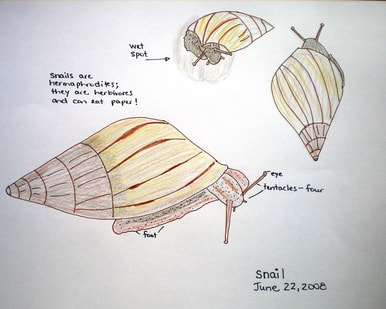
|

Should we not teach art?
You may, of course, have art lessons at other times to your nature journalling sessions, but nature journalling is best seen as a pursuit rather than academic study. It should be enjoyable. Anna Botsford Comstock stresses that any child who does not want to draw, should be given another activity to do, for fear of turning the child off of nature - which would be far more disastrous than the child not producing a neat drawing. Art lessons however can be given to all - however I would still want the child to enjoy the work - as art will not be a serious occupation for most, but can afford many pleasurable, relaxing moments, both in childhood and adulthood, from which I would not wish any child to be excluded.
Keeping a nature journal
'I draw and work in my nature journal for three reasons: to see, to remember and to stimulate curiosity.'
John Muir Laws
Note how John Muir Laws does not suggest that the journal helps you 'to learn to draw.' It is not the primary reason - though it may well be a by-product as it is true that learning to draw is mostly down to learning to look.


Who can keep a nature journal?
|
|
Older children may become quite sophisticated in their drawings and indeed, as nature study is science, their drawings may well help them in their studies of Biology. This then gives purpose to older children and acts as a stimulus to continue their recording long after they may be tempted to stop.
Drawing from memory
Children, can be taught to draw from memory, alongside sessions drawing with an object in front of them. The key thing is to look not for a 'gift' in drawing, but evidence of careful looking. It can be made into a kind of game too: "I'll show you this object for 2 minutes, then I will hide it and you have to tell me what you remember seeing." Take turns to be the observer and the shower.
How can I teach nature - I know very little myself!
Do I need expensive equipment to draw nature?


  |
  |
May you give your child a lasting legacy of happy times learning about creation. Happy drawing and may our God have all the praise!
Christian Nature Magazines

An aid to nature study for ages 4 to 8
|

Learn about Nature for ages 8 to 100+
|

Investigate Nature - for the academic naturalist aged 14+
|

Why did you decide to home educate?
On a more serious note we both had concerns about what they would be taught in school – and this was in the 1990s! I think at first we just considered individual topics – creation, morals and so on. Later it began to dawn on us that it is not just that a materialist education (that's what state school provides) is wrong in some areas – it is foundationally flawed. It was only when we were actually in the throes of teaching that we realised the force of Colossians 2:3 “...in whom [Christ] are hid all the treasures of wisdom and knowledge...” and that the Bible tells us three times that “The fear of the Lord is the beginning of wisdom/knowledge” for a good reason! Psalm 111:10, Proverbs 1:7 and 9:10.
This sounds fanatical, perhaps. I do not mean that we sat the children down with no other text book than the Bible. I do not even mean that we used only textbooks by Christians produced deliberately with a Christian world-view. Unbelievers are often correct in what they teach and can sometimes make profound observations. However, when they do so it is because, unwittingly they are borrowing from a Christian world-view. A truly materialist world-view will never give you a consistent picture of reality and indeed lacks a reason or basis for the existence of logic and reason itself.
Did you make any key discoveries along the way?
Then there is geography. Wrong geological assumptions underlie the teaching of physical geography in ordinary textbooks and in learning more generally about other parts of the world we often needed to research what is going on in the way of missionary activity to gain a true picture of what a country is like. We found we had to constantly bear in mind that this is God's World not Our World.
When approaching the topic of learning to read, Christians are inspired by the knowledge that God's word is a written word. Writing (and indeed language itself) is not something humans have just invented for their own convenience. To know for himself what God says in His Word a child must learn to read. This means that reading is of the utmost vital importance. All over the world, literacy comes in the wake of Christianity because it is the God-given vehicle for apprehending the very revelation of God Himself.
As parents, we quickly came to the conclusion that everything we taught had a different perspective, a different emphasis. Even Maths – yes Maths! – looks different when you realise that maths itself is a fundamental evidence for the existence of a consistent Creator.
All this made us consider things that previously had not entered our heads. If your child is in school you can ignore these issues. Your child is taught everything as though God does not exist – as though his immutable nature is not the very reason why one plus one always makes two. Personally, I found it deeply inspiring and mind expanding as well as humbling to realise that before I began home educating I had been just ambling along with a set of anti-Christian principles governing how I perceived some of the most basic aspects of life. I think my own education really began when I started teaching my own children.
What books did you use?
We had the privilege, due to the era in which we were doing our home education, of being able to collect very cheaply from second hand bookshops and charity shops a large number of older educational books which were much closer to a Christian world-view in outlook than those of the present day. We imported American Christian text books too but found that generally older British books met our needs better – as well as more cheaply!
Why did you decide to write your own children's history book?
What made you compile The Mothers' Companion flashdrive and how did you do it?
However, when I approached those publishers and authors who could be found, I was amazed at the combination of enthusiasm and apathy I encountered. Some authors were delighted that their work was still of use and happily gave permission. Other publishers could not be bothered to trawl through files etc. and simply said that they had no idea what agreements they had had with authors (if indeed they knew who the authors were) but I could use their materials so long as I was prepared to withdraw them should anyone object. I began to acquire a thick file of permission letters. Almost nothing I had used could not be reproduced except the Ladybird Key Words Reading Scheme, of course! I bought a digital scanner...
Looking back on it, I cannot imagine how I ever did it. There were thousands of pages of text recognition all needing patient checking. Many of the best books were so old they did not scan well and the resulting “raw” scans were almost unintelligible. I ploughed on evening by evening, after the children had gone to bed, scanning the books they had used the previous year. Volunteer checkers were a great help. One dear lady from Northern Ireland was an insomniac who checked vast amounts of print in the wee small hours while the rest of us were sleeping!
The results were initially published on CDs, but now the whole thing comes on an easy to use flashdrive, providing a complete curriculum up to age 12 which can be printed out as needed by the user. Some people use it just to dip into. Others have found it a great help when getting started in home education. Some use the “diaries” section for each year as a framework for their own activities and some plough through everything lock stock and barrel!
Nowadays I also have a website https://latinigcse.weebly.com which uses Mothers' Companion materials to provide a complete free course in Latin for IGCSE within a Christian world-view.
What prompted you to start writing books of your own?
What with the Mothers' Companion and The Story of God's Dealings with Our Nation, and involvement with the Christian Education for Deeside Exam Centre (that's a whole story in itself) not to mention the actual education of our children, I had no time to write down fiction of my own anymore. I was always conscious of the gap there was in British junior fiction for really good quality novels with a Christian perspective and often had ideas of what I would write if I could. I was also aware that there was a certain type of home educated child, “the totally voracious reader” who needed a vast quantity of through-put and that good quality material was quite scarce. When I began to approach “retirement” (my youngest son is now just 20) it was like a dam bursting and all the ideas and plots I had mulled over were scrambling to get themselves down on paper.
What do you like to write – and what do you aim to achieve through your books?
What books have you written so far?
Christina's latest book, the next in the series, is now available:
https://www.ritchiechristianmedia.co.uk/product/eastwood-wulfgar-saxon-wulfgar-and-vikings
Do you have any advice to young writers?
Fully indexed to help you find the lesson you need!
For all ages!
As with any question in life, we must go to the Bible alone, for it is here that we will find the wisdom we need and then we must carefully seek, with much prayer, the way to direct our children's hearts towards God and his ways. For in the matter of training (or discipling - for that is what discipline is), the heart is the subject of the matter. In disciplining a child, we a seeking to bring the child's heart towards God and his best standards for living. God draws us in love, but he is not ignorant of our rebellion. He graciously and loving disciples us and sometimes it is hard. But it is through these hard times that we learn. We will surely damage our children if we try to avoid the harsh realities of the natural laws of cause and consequence.
And fear not them which kill the body, but are not able to kill the soul: but rather fear him which is able to destroy both soul and body in hell. Matthew 10:28
Much confusion is brought about when we listen to the world's voices. What we have to remember is that most of our modern methods of raising children are based on the theories of men who rejected the Bible. These men, of the late 1800's - around the time when evolution was becoming more and more popular - did not believe that children are born in sin. They believed instead that they are born neutral and that life's experiences turned a child towards that which is 'right' and that which is 'wrong'. So the idea goes, give a child a good environment to grow up in, with nothing but kinds words and gentle leading and the child will turn out well. But, correct a child, and you will do much damage to its self-esteem. Nothing has caused more confusion - because as any parent soon finds out - however good the home environment, original sin soon rears its ugly head. Parents are generally ill-equipped to know how to handle the child's first wilful 'No!'.
Of course - God-honouring parents will strive with God's help to provide the best home-environment that they possibly can, it does play its part, but it is not fool proof, not guaranteed to work because the heart is full of sin. To threaten parents into being fearful of correcting their child, in case of damaging their child's self esteem is not biblical and therefore Christians need not feel guilty however much pressure is applied by the world to feel so - when they discipline their children.
Learning to prayerfully disciple our children is never easy: you will get it wrong sometimes! Confess your sin to God and to your child if s/he is old enough to feel wronged and ask the Lord for daily grace to continue. Parents are learners, for the rest of their lives!

Last time we looked at some poems for character training. This time we have some tips for child training in general. I still have not managed to track down whether or not this old book is out of copyright, but I am sure that the author would be only too glad for his work to be given a further lease of life in this day and age that has so forgotten how to practically apply God's Word. However, if anyone claims the copyright, please contact me and I will remove the post.
Friendly words to Fathers and Mothers
Oh, what a solemn responsibility rests upon the father and mother to 'Train up a child in the way that he should go." (Proverbs 22:6)
The little folk who sit around our tables and play about the house cause many anxious thoughts when we think of the dangers of the path of life which they must tread, if they live. And then we think of the tremendous fact, that our children are hastening to an eternal goal - heaven or hell - O what searchings of the heart a godly parent feels and how such exercises lead to the Psalmist's prayer: "Let Thy work appear unto Thy servants and Thy glory unto their children" (Psalm 90:16)
I feel it needs special grace and wisdom to "Train up a child in the way he should go." I have been much impressed by the injunctions in the Word of God concerning the obligations which fall upon fathers and mothers. The children of Israel were enjoined: "When thou buildest a new house, then thou shalt make a battlement for thy roof." An Eastern housetop was flat, and served as a garden, a resting place, a playground for the children, and many other useful purposes. A surrounding wall - a battlement - was necessary to prevent people falling from the roof.
May not these "battlements" set forth the rules, principles and teaching which a faithful parent will build around a house-hold to prevent his children falling into many dangerous snares? The precept enjoins, "Bring them up in the nurture and admonition of the Lord." And this will be a great concern of heart to a godly parent. As the husband-man ties the plant to the stake, training it upward, even so the children should be trained in a right way, and fastened to the stakes of morality and uprightness by loving ties of parental affection. This was enjoined upon the father and mothers in Israel:
"And thou shalt teach them (statutes) diligently unto thy children" (Deut: 6:7)
The marginal rendering of the word "teach" is "whet", or "sharpen," and conveys the suggestion of a "whetting" or "sharpening" a scythe - a significant reminder to parents to continually sharpen the minds of the children in the knowledge of what is right and wrong.
The most important method of teaching is by EXAMPLE. It is vain for parents to enforce precepts and principles which they do not keep themselves and live in daily life. If the command, " Train up a child in the way he should go," is to be carried out, the parent must be in the way, and lead therein by a daily example of right principles in the path of life.
Three things to watch
1. The tongue
Idle words, exaggerated statements, frivolity, falsehood and wrong speeches should be checked and corrected. It is a sad sight to see boys and girls who are beyond parental discipline, and who 'answer back', and disobey, and do "as they like". A solemn harvest will be reaped by such parents, and too late, the folly of not keeping children under right government will be proved.
2. The hands
It should be a "law of the house which altereth not" to allow no novels, poisonous books, card-packs, and harmful things into the hands of children.
(Note: we may think these things hard, but novels belong to the realm of entertainment and immorality, which leads astray - children should grow out of innocent story books as they age; card-packs to the house of gambling and poisonous books these days will include the many promoting witchcraft through magic (Harry Potter etc..) and alternative lifestyles. To these I would now add computer games and mobile phones, with their addictive nature, at the least.)
The hand which takes the forbidden lump of sugar (or biscuit!) must be checked. A little thief may imbibe habits of dishonesty, and bring sad havoc to a parent's home and heart. And the hand which strikes the angry blow must be checked also.
3. The feet
We live in days when children are allowed great latitude as to what they can do and where they can go, but the Word of God is the same. Can a godly parent allow his child to go to the sporting field, and places where bad company abounds? An honest conscience will answer "No!" The children of modern days will call such a method of "training" strait-laced and narrow-minded, but let every father and mother stick to the Word of God: "Train up a child in the way he should go." The Word of God is old -fashioned, and woe to the parent who departs from its laws.
If home life was what it should be, how many youths and maidens would be preserved from going out into the worldly society to obtain so-called pleasures.
(Note: Sadly, this must now include many non-serious church youth groups, with their occasions for socialising, over which parents have no control, or introduce youngsters to pastimes which they would be better off without (going to the cinema, snooker/ pool etc..). Christians in times gone by avoided such meetings, as they knew the dangers of putting young people together for times of 'pleasure'. Meetings at chapel should be for the serious study of God's Word with the exhortment to live a godly life and shun the world.)
Lawful pleasures should be provided by all fathers and mothers who value the happiness of family life. What are lawful pleasures? Good books for the children to read, music and singing in the home, edifying and instructive conversation; country rambles; many helpful studies in the world in which we live; profitable hobbies and occupations; and a thousand things leading to the fulfilment of the precept, "Train up a child in the way he should go."
(Note: These days we are tempted to fill our lives with much that is unprofitable. Beware of how technology is used in your home. It can be used to good profit, but avoid its use, both by yourselves as parents and by children, for mere passing the time and entertainment. As such, it provides an enormous snare for wasting many precious hours.)
It should be a special anxiety of mind to a godly parent to lay before the dear young people the solemn realities of eternity, death, and "judgement to come." What a proper sight to see little ones in the house of prayer, and godly parents should make attendance at chapel and school a "law of the house." It is recorded of Abraham, "He will command his children, and his household after him."
Constant grace
I have dropped these "ears" of friendly counsel for parents who profess to know the truth and feel the burden of parental responsibility. Some parents may say "Alas, I wish I could train my children in the right way; I would seek their best welfare, but I feel to come so far short of what a parent should be."
The Word of God only shows one way to be sure to "train up a child in the way he should go," -"Let us therefore come boldly unto the throne of Grace, that we may obtain mercy, and find grace to help in the time of need. The secret lies in the word GRACE. "The Lord will give grace" to the needy; grace to be a daily example to those who live around us; grace to be living sermons to the young. And so, godly, anxious-hearted fathers and mothers, "Grace be with you all."
by Herbert Dawson, C. J. Farncombe and Sons Ltd, London, 1922
It is a series of sermons told to the young people in Bethersden Baptist Chapel - not so very far from where I live - by the author, who was the pastor there. This man understood children - and he understood the gospel. He had a knack of directing the shafts of truth accurately to the target - the child's soul. This is rare in our modern age. We generally do not understand ourselves, let alone the gospel, well enough to do so.
Reading through I found these verses and have copied them out to hang on the walls of my kitchen. My young people are aging now - but none of us are too old for these verses! We are never too young or old to be on guard for the attacks of the flesh, that come from our 'old ' heart. Sadly, though we have new hearts as Christians, we can still operate by the old one and live for self. Learning to deny ourselves is often a hard and painful course of lessons throughout life.
Have a look at these!
Angry words hurt too, as the poem below tells us so well:
I have made them available to you as a pdf download, with 2 pictures to colour (from the book) and each of the verses arranged for copywork.
I am sorry to hear that you are struggling with anxiety and worry. I have just jotted some thoughts down here for you to consider, gleaned from years of struggling with chronic anxiety myself and from what I have learnt from sound Christian sources. I have found from personal experience that the world's psychological 'answers' are but 'empty cisterns' and best avoided by the Christian. We do not need them however, as the Bible, as always has the answers to all of life's problems. Biblical Christian teaching on these things is hard to find though, as many have sold into the counselling model in a 'Christianised form'. However, true biblical 'psychology' comes from a completely different angle as the Christian is a new person, no longer controlled by the flesh (or does not need to be). Biblical help for anxious Christians turns their thoughts away from self-seeking (and ultimately steering life along a course with which I am comfortable), towards God, the one in whom true healing is found, as He alone has the power to cancel sin and gives us new hearts that no longer desire to glorify self, the root cause of our problems. Poor teaching leaves many of us bereft of help.
Christianity points to God, the flesh tries to bring God down to us. Man's chief end is to glorify God. We are to do God's will, not expect Him to do ours. God has dealings with His people that the world cannot understand. The Christian is often called to go through various trials. Trials are designed to make us more holy and increase our dependence upon the Lord. What matters most is that the trials are sanctified to us. Often these trials will be uncomfortable, but when God is dealing with our heart, immediate relief may not be helpful. We can of course, and indeed should pray, but must be prepared to expect God to reply in His way and time, as that is what will be best for us.
There is quite a lot here – but I trust something might be of help to you.
First - a word or two to help you understand the effects of worry on the body: it causes bodily symptoms of discomfort. We might call it STRESS - yes a modern word that you won't find in the Bible. The Bible instead talks about the seat of our emotions - the 'bowels'. Look it up! Here is one verse from Job 30:27
'My bowels boiled, and rested not: the days of affliction prevented me.'
Maybe this describes some of you now!
Please do not underestimate stress, as I have done many times before. It can do the most bizarre/horrible things to the body – and we all respond in slightly different ways. Whether or not you have something serious/otherwise wrong with you, or are going through tough times for whatever reason, if you are worrying then your body will be under increased stress! Stress brings its own set of symptoms and makes everything else much worse. It often affects the bowels and digestive system with uncomfortable symptoms, but affects other parts of us too. When you are stressed it is easy then to start panicking and worrying that the symptoms ‘can’t just be stress’ or reacting to feelings! How many times have I thought that – but despite years of weird symptoms that have baffled the docs and umpteen tests for all sorts of things – all have so far cleared up once I stopped worrying! I have even worried about the amount of worrying I do! And in actual fact I worry least when I am actually ill with a defined illness. It is also very easy to deny stress. Be honest with yourself!
The world tells us that stress is bad for our health - which can make us worry more when we get stressed. Do bear in mind that the saints of old did not consider how stressed they were getting when they carried out God's commands. It must have been very stressful building an ark against much opposition. The Apostle Paul much have suffered greatly for his faith: but these men did it with any eye to God's glory - not to their own comfort - trusting Him to take care of them. We easily lose sight of this in our self-centred, fleshly thinking. You will not die before the Lord is ready to take you. If he sends 'stressful' trials your way - will we say: 'Lord, this is ruining my health, it's too stressful!'? I trust not - though we might actually be implying it by our response to the situation!
The problem, as always is not just a word, i.e. 'stress'. It is our response to the situation in which we find ourselves. Two people can go through the same experience and come out with totally different reactions. If we were to truly live by the Spirit, perfectly, like The Lord Jesus Christ did, then we would always be looking to the Lord and be able to resist the temptation to become overly absorbed/overwhelmed by our feelings and emotions. Sadly, because of the fall, we are prone to be easily thrown off course: but Jesus knew this. Read your Bible and see how he understood his poor, feeble disciples: their panic when they thought the ship would sink, their confusion, their simplicity! Friend - He understands you and does not condemn you for struggling. However, He must often think 'Oh dear, foolish one - if only you could/would believe what I have told you!'
Note: What we worry about most is coping with fear (fear of the unknown) – rather than illness/the problem. This might be hard to believe, but it is the fear of the feeling of fear that causes us problems.
Panic attacks are nothing but fear feeding fear and it spirals out of control and they are VERY scary. Fear is a very powerful emotion that can make our fears seem unsurmountable and very real. Learning that I was not actually afraid of the situation - be it health or other, but rather afraid of the feeling of fear associated with it, has helped me enormously.
We can focus on the symptoms of fear and everytime we feel it coming we start to panic. We can even try and control the symptoms by tensing that part of our body - making it even worse. Because fear is the issue – not our symptoms per se, we are able to control them. Our symptoms are out of our control – but we are exhorted ‘do not fear’. Think how many passages of scripture tell us that. It would make a good Bible study to look them all up! We have trouble heeding them as we listen to our feelings rather than using our mind to think rationally. We expect to read Scripture and feel calm, and when we don’t we panic more or think we are not good Christians.
We need to think past our symptoms and ignore the unhelpful feelings and learn to remain grounded in God's Word. This can take time (and for me at least has needed much practice!) - but try and see each episode of fearing as another opportunity to learn to lean upon the Lord and take Him at His word in faith. The flesh relies on feelings - the Christian should rely on faith - which may mean going against feelings and that is hard. We need to ask the Lord for help. I'm sure Abraham did not leave Ur without any feelings about the journey ahead of him - into the unknown. He was commended in Hebrews 11 for His faith - not his feelings. He was guided by what he knew of God rather than what his feelings told him. I'm sure he had some pretty tough times when he was no doubt anxious - or tempted to be so!
We live in a psycho driven world – which puts self at the front. Even Christians are not clear how the Bible can help us with our problems as we have sold into the ‘counselling’ industry, bypassing our Bibles. Many churches are focused on self - in their worship and palliative 'sermons' that do nothing but stroke the ego: 'God loves you' we say as if that is the whole message. We surely must start with the truth 'For all have sinned..' (Romans 3:23). CBT is very person-centred, rather than God-centred. It makes your happiness life’s goal. This book by Dr. Martyn Lloyd Jones has the best description of ‘Biblical Psychology’ for want of a better description, I have found. It is a series of easy to read sermons based on Psalm 73, but in it, he outlines biblical psychology which is hard to find elsewhere. He had an acute God-given ability to apply scripture to our lives with all of its hard questions and difficulties.
Here is info about the GAPS diet that we are using:
http://www.gaps.me/index.php
http://www.gapsdiet.com/
It is designed as a temporary diet to bring about healing, though as you come off, you will probably not return to what you were eating before as you will have learnt more about food and your body.
Animal fats, meat/eggs/fish and veg are the mainstay of eating naturally, with a little fruit/nuts and small amount of unrefined sugar (honey, date syrup, molasses, rapdura), with plenty of probiotic foods to populate the gut with good bacteria – either though fermented foods - or by taking probiotics. Soaking grains makes them more easily digestible – boxed cereals are bad news to health. I learnt to re-do most of my recipes to fit this before we started the diet.
This website has been of great help to me in days gone by with plenty of family friendly whole-food recipes, but there are many more out there!
https://gnowfglins.com/
'But I eat healthily,' you may say: the problem is the years of stress/over-the-counter/precription medicines/dieting that take their toll on our gut. In most cases, the gut needs time to heal. There are several ways you can do this - the GAPs diet is quite drastic - do some research.
https://mindthegapsdiet.weebly.com/all-posts/magnesium-oil-and-anxiety
There are two aspects to consider when we start to worry: the physical and the spiritual.
- You do right to get checked out by a doctor. Leave the results in God’s hands.
- Do go easy on yourself – stress is real and it can make you sick - at the very least, it wears you out. Take as many pressures off of yourself as you can – looking after a young child all day can be stressful and it’s often child discipline that gets out of control when we are self-focused on worry, which makes it worse for everyone!
- Do ensure plenty of sleep – be in bed by 9pm or as near to as you can and have at least 9/10 hours sleep – more if needed if nights are disturbed for any reason – including insomnia. Sleep is when the body heals and makes you better able to cope with the days problems/issues.
- Make every mouthful of food count – stay away from dead food (most readymade stuff) and if you do not feel like eating, make sure the little you do eat is nutritious.
- Keep yourself busy - and talk to others - not about yourself necessarily, but it helps you to stop feeding the fear. Resist the tempation to keep Googling worrying symtpoms. Learn where the 'off' button is - literally if necessary.
- Drink plenty of water (not tea and coffee/fruit juices)- dehydration can make anxiety worse.
- Take moderate exercise - it does wonders for you - fresh air and daylight on the skin (not just sunlight) can lift the mood.
- Magnesium will help with sleep if you apply the magneium oil before bed – especially to soles of feet and replace that lost through stress.
Do try and keep up daily devotions – I know it’s hard when you cannot sense God’s presence. Resist the temptation to feel a failure as it only keeps you from the Lord – who actually understands how you feel and just wants you to honour Him by casting yourself onto Him – it is the flesh that suddenly wants to return to a doctrine of salvation by works when we feel sinful! You know that thinking: If I was a good Christian I wouldn’t worry so much – what must God think of me? I’ll stay away until I feel more worthy! NO!!! Pour out your heart – tell Him of your struggle with fear - enlist the Spirit's help and continue to pray and read the Bible – even if feelings don’t accompany it. Remember – feelings are not the final word - they are unreliable and can/do deceive.
Controlling anxiety in the short term:
Here are some practical tips for controlling a bout of anxiety: First, face fear head on – as you feel the feeling start to ‘wash over’ you (that’s how it feels to me) – just freeze your thoughts and stand still. The feeling will mount until its nearly unbearable and then amazingly, it will subside. Now you might have to do this several times on the trot... but over the course of the next few days it will happen less frequently (more on days when I am tired). This will calm your heart and give space for your mind to take control and stop cyclical fear leading to a panic attack. In short- you will learn that fear is only a feeling - and it goes! The trouble is – we leave it too late. If we learnt to say ‘ok – it’s just my feelings running out of control, but it doesn’t change anything I believe about the Lord – He is unchangeable' – the minute we recognised fear mounting, it wouldn’t build up and get us freaked out. When your stomach gripes or your heart is jumping and you start to panic – try thinking: It’s nothing to do with my stomach/heart – it’s just fear and I am in control. Say it repeatedly to help you ignore the feelings until they subside. this is basically not responding to the feelings so that they cannot overwhelm you.
In the longer term we need a better strategy - aiming toward not getting to this point of acute anxiety in the first place. We want to grow in faith:
Anxious states may come as a result of months of small niggles about life's issues - and they can build up slowly and catch you unawares. Learn to examine your thoughts daily and make sure they are biblical. Make sure you are thinking biblically and not according to the flesh: the Lord is in control (don’t expect feelings to back this up immediately). This will mean studying your Bible, spending time in prayer and learning as much as you can about God and His ways and His dealings with mankind. You know, it is so easy to think that because you are saved, you know about God - and how easy it is to not realise you have heaps yet to learn! As I have said, good teaching is rare - in fact dare I say, we no longer know what good teaching is! If you want a good primer, so to speak of Christian doctrine - I can reccomend the Daily Remembrancer by James Smith.
If the Lord sends an illness your way, learn to leave the consequences to Him. I have ultimately had to realise I was afraid of dying after an incident when I was young – our past does affect us now and we can have unbiblical thoughts that we have not yet recognised/changed.
Do try and think what might have got you to stress overload point. It might just have been sudden onset physical symptoms – but it could have been a period of uncorrected, wrong thinking about life’s problems/issues that led up to it and made you vulnerable.
An out of control heart (the feelings) will lead you to think ungodly things – like distrusting God’s goodness. So do self-examine and repent as necessary – not for feeling afraid – but for acting on the feeling. Self examination when you are feeling a little calmer is good for the long term in helping you to overcome the temptation to give into anxiety easily. It is not sinful to feel wrong things – but how we respond is critical. You can feel all over the place, but still have your mind fixed on the truth. You hear people saying – “my body’s doing crazy things, but I am at peace”. Peace does not necessarily mean ok feelings. It means your mind is stayed on the Lord and His Word. The feelings will then eventually calm down – but in the meantime it can be quite an unpleasant sensation and you need to be strong in the Lord to resist the temptation to respond to them wrongly.
I’ll stop there.
Please do not think you are alone - many people struggle- especially ladies. Many suffer in silence. Maybe you are one of them and I hope the things in this letter give you some hope. Dr. Martyn Lloyd Jones's book needs reading!
With Christian love
However, sport is fun as well as good for you, so we play football/sports with family and friends. This helps to bind the family together, rather than pull us apart.
There are many activities you can do, which encourage children to get their daily exercise, that are cheap.
You can equip your home-school with a range of small pieces of equipment to encourage your children to run around. You don't need all of these things - but I would suggest that balls are essential. Being able to catch a ball is a skill all children should have. We have only listed products that we found helpful and that our children used. Many things are often bought, but some you get more benefit from. These are ours! Do scour charity shops! Also look out for NCT sales and jumble sales.
  |
  |
  |
Indoor fun: The fun physical ideas in this book are great. We used them when the children were aged 2 to 8, especially in winter to burn off some energy. They eventually got too big to have room to move in the house! They loved it too, and have fond memories of the exercises.
CD included: not pop music. |


  |
Football: After having bought two cheap (Tesco style) goals, which didn't last very long, we finally splashed out on a 'Forza' goal. It seems to be well worth the money spent - strong and weather resistant. We recommend this product.
|
  |
When children are young/have special needs, they can be frightened of a hard ball hitting them. A soft large ball is easy to get hold of and no fear of it bonking you on the nose!
|
  |
As they get more confidence they can move to pvc balls, which are not hard and so will not do much damage to your garden!
|
  |
And then they can try catching and throwing smaller balls.
|


Swimming lessons are fine if you can afford them, but if not, don't panic! Teaching your child to swim is not difficult! We equipped ourselves with age appropriate floats to aid water confidence (we didn't have children who naturally enjoyed going under water!)
One easy way to learn to swim is by walking on hands in shallow water and then increasing the number of times you can kick your feet.
Pool Noodles are great for instilling confidence and fun to play with too!
  |
  |


You have made the brave decision to home-school. Now what? How do you practically go about educating your young child?
In this post I will round up various articles/sources of information to give you a head-start.
On a general note, these two organisations both offer support and advice about home-educating in the UK.


CHESS
|
Christian Home Education Support Service
Providing information and support for Christian families. |
Teaching your child yourself
you are ideally suited! You do not need to be clever to teach a 5 year old, and anyway, you will grow in knowledge and teaching skills with your child. You do need patience and determination to do whatever is necessary to help your child.
I would recommend that you read this little book soon, to make sure that you understand your biblical mandate to give your child a Christian education

1. An Educational Philosophy
2. A Homeschool Curriculum
Your chosen curriculum will in most part shape your family life: don't choose one that will ultimately make you its slave with your children tied to a desk/computer screen all day. Choose carefully!
I advise one that is as simple to implement, flexible, but effective as possible and that doesn't break the bank. You also want one that can be moulded to fit your family, rather than making your family fit the curriculum. In this way in can be used with multiple children if necessary, without parents having to spend unnecessary amounts of time planning different curriculums for different children, which could easily lead to burn out. My personal recommendation is the Robinson Curriculum, the one we used, which fits the bill perfectly: inexpensive, very good results if followed carefully (which is simple!) and can be used by all children in a family, freeing the parent from endless preparation. See why here. It partners very well in the early years with the Mothers' Companion curriculum (See below) - which can also be used as a 'dip-in' resource, or with my Home-Education Projects (see bottom of page).

A complete curriculum for ages 3 to 12 on a USB stick!! Amazing value at only £20! Written by a Chrisitan, veteran, home-schooling mum.
For more ideas you might like these posts on specific subjects:
Reading/spelling:
Teaching Reading in the Home-school

Writing:


Teaching UK History
Home-school Geography


I will paraphrase the text, with actual quotations in italics. I pray that it may be a blessing to all young men who read it.
He becometh poor that dealeth with a slack hand: but the hand of the diligent maketh rich.
Proverbs 10:4
In the day of prosperity be joyful, but in the day of adversity consider
Eccliesiastes 7:14
Imagine two young men setting out in life with equal advantages, money, connections and prospects. They have studied and trained and are about to start work. One of them succeeds, a propitious gale seems to fill his sails and a favourable tide to flow in, to help him onward in his course from the very time of sailing. He makes a prosperous voyage and enters safely into harbour with a rich cargo. He does well, enjoys promotion and is paid well. He has good standing in society.
But there is a reverse side to this - early failure.
In this case, the vessel has no sooner left port than it encounters unfavourable winds, is tossed upon the billows by tempests and dashed upon the rock, or stranded upon the shore, becomes a wreck. The young man started out with big ambitions, but they terminate in disappointment and he is soon left without an income. This is a very common situation in the UK.
May it young men never be yours.
We must ask what made the difference between success and failure. At this point we must quite squarely put aside chance or luck as some may call it. For the Christian, there is no such thing as luck. God is over all and rules all in and through his Providence. Providence no doubt gives advantages to some which it does not bestow upon others. Scripture is full of instances of this kind: how conspicuous was Providence in the history of Joseph. How manifest in the life of Moses and so on.
Let us then examine the causes of the two different results of success and failure.
1) The possession or want of ability, cleverness, good judgement and tact in business will often account for success or failure.
Success in any department of life, without a competent knowledge of the means of obtaining it, cannot be expected, and ordinarily is not obtained. Some do seemingly 'land on their feet', but they are the exception to the rule and the hoping to follow suit is not a method to be relied upon. A man must at all times, especially in this age of competition, (1800's and no less true today, if not more so!) know how to buy and sell. He must be a judge of articles and prices, thoroughly know not only his own trade but the principles of trade in general. Business is an art and a science too, and he must be acquainted with both. He must know the markets and the times. How do you learn these things: You must be thoughtful, observant, diligent, both in training and once trained. You must be neither lovers of pleasure, nor companions of those who are such. Next to being right with God, it should be your aim to gain a complete mastery of your trade.
Who are the men who succeed? Not the dolts, the ill-informed or the half-informed, but the well informed. Who are the men who fail? Usually you will find them not the well informed, but the half informed, or the ill-informed.
Your faith in God cannot, however eminent, cannot supply the want of the knowledge and the habits of a good workman. Godliness it is true, is profitable for all things, having the promise of the life that is now and of that which is to come. But then it is not godliness without other things but with them.
A good and holy young man is not to expect to succeed by the favour of God, without either hard work or ability. We must not expect God's blessing as a substitute for these things. God does not bless pious dolts who are ignorant due to their own neglect. God will not set aside the general laws by which he governs the social world in favour of religion, any more than he will those of the natural world.
Beware of over-stocking and trading beyond your capital; a very frequent source of ruin to young tradesman is allowing commercial travellers to force upon them too large purchases.
A good point to remember - don't spend what you haven't got or get in stock too much of what you may not sell. Make it a rule never to buy using credit that you can't pay off immediately the bill arrives..
Lesson: Learn your business well - study hard at school, and later in your job. True learning begins once school work is left behind. Read, read, and read.
2) Success or failure depends a great deal upon a good start.
Bad beginnings can be repaired, but they are not usually. A first wrong step is often, if not always, the beginning of a series of steps all wrong. Great care, caution, circumspection, and forethought therefore are necessary. Many begin too soon: they are impatient to be masters before they are prepared for it. They are unwilling to bide their time, and often mis-calculate their ability.
The most successful business men have been both careful as well as able. Creep before you try to walk. Walk before you run and run before you flee!
Let there then be much reflection, counsel, much prayer in such an important step as setting out in working life. As this, like marriage is a step for life, let it be taken with care, and think no time lost, or too long, which is necessary, to enable you to tread firmly and steadily at the outset. For every person that has repented of starting too late, ten have repented of starting too early! Next to seeking counsel from God, by earnest and believing prayer, seek the advice of disinterested wise and experienced people. Do not be like some who have made up their mind as to the outcome, then seek advice, and when it is contrary to that which they wish to hear, reject the advice given and follow their first proposed course of action. This is the sure way to ruin.
Lesson: Count the cost: don't rush in to things. Pray.
3) Success of failure are dependent upon diligence on the one hand, or neglect or indolence on the other.
We read in Proverbs: The blessing of the Lord maketh rich. And then: The hand of the diligent maketh rich.
Both are true and they stand related to each other. Our hard work cannot be fruitful without God's blessing and God's blessing is not bestowed without man's industry. The Lord's providential visits are never granted to loiterers. Moses, David, and the shepherds at Bethlehem, were all keeping their flocks, and Gideon was at his threshing floor, when God's revelations were made to them. How laziness is exposed, condemned, branded, in God's book! Let a man have ever so good a knowledge of his business; let him begin with all the advantages of capital, connections and situation; yet if he be of an indolent and self-indulgent habit, a late-riser, a lover of pleasure; a gossiping neighbour, he will soon furnish another evidence of the truth of Solomon's words, "He becometh poor that dealeth with a slack hand."
Be diligent! Be like Henry Martyn the affirmed and holy missionary of whom it was said, “That he was known as the man who never lost an hour."
Lesson: count every minute as precious. Think how many we waste on idle pleasures. Be careful who you spend time with as your companions can influence you more than you can imagine. If you profess to be a Christian, then flee from the world and everything that belongs to it - love of self (selfies included), ungodly entertainment, be it worldly music (including addictive 'Christian rock' which is no better for its Christian words), films/theatre. Give every minute to serving the Lord.
4) Method and system have much to do with failure or success.
In this I include promptness as opposed to procrastination. No habit can be more fatal to success then the wretched disposition of postponing until another time that which ought to be done, and can be done, at once. Procrastination has ruined millions for both this world and the next. There is a class of adverbs which some young men seem not to have studied, but which are of immense importance in all the affairs both of time and eternity. I mean the words, “instantly," immediately," "at once," "now," for which they unhappily substitute "presently," "by and by," "tomorrow," "at some future time,". Young men, catch the inspiration of that weighty monosyllable "now". Yield to the potency of that word "instantly" and to use a still more business like term, acquire a habit of "dispatch". To do this, do not only do the thing that should be done, but the thing that ought to be done next!
Be punctual. Punctuality is of immense consequence. It has been humorously said, "Some people seem to have been born half an hour after their time, and they never fetch it up all their lives!"
Lateness is not only a vice on the one being late, but also on those waiting for him. "You have caused us to lose an hour," said a gentleman to another, for whose appearance twelve men had been waiting.
"Oh, that is impossible," replied the guilty man, "for it is only five minutes after the time."
"Very true," was the rejoinder, "but there are twelve of us, each of whom has lost five minutes."
Lesson to learn: Do not keep anyone waiting - be it for an appointment or for payment if you wish to prosper. Do not put off those things that need doing now. This needs practice and it will sometimes be hard to fight against natural inclinations towards ease, especially in a day and age that so promotes care of 'self'.
The Scriptures exhort us to "redeem the time." Order is no less essential to system and success than promptness and punctuality. A disorderly man wastes not only his own time, but that of others who are dependent upon, and waiting for him; nor does the waste stop here, for what a useless expenditure of energy and a painful sacrifice of comfort are ever going on with him!
Lesson: Look at the different areas of your life. Which are disorderly? Start working now to address these areas and bring about changes which will stand you in good stead in years to come. Others call disorder a peace stealer - as we cannot enjoy peace if we are forever in a tiz over what we have lost, or for being late.
5. Economy has a most powerful influence in determining the failure or success of a young business man.
This applies equally to personal, domestic and business trade and the man who would succeed in life must reduce them all to the lowest prudent level. In order to keep down the expenses of the trade, he must do with as little purchased help as he can; and to accomplish this, he must be hard working and ready to learn. As to personal expenses, let him avoid all unnecessary consumption of money in dress and ornaments. Let it be no part of your ambition young men, to be noticed and admired for that with which the clothing retailer, and the jeweller may bedizen (to dress or adorn in a showy, gaudy, or tasteless manner) the veriest fool in existence. How mean and petty is foppery (affected and excessive concern with one's clothes and appearance), compared with an enlightened mind, a dignified character, and the beauties of holiness! I am not an advocate for either meanness or slovenliness. Cleanliness and neatness border upon virtue, as excessive foppery and expensiveness do upon vice. It is unworthy of a female to be inordinately fond of dress: but for a man to love finery is despicable indeed.
Avoid also the love of pleasure. The man who is bent upon enjoying himself who will have his amusements and companions and frequent sessions of recreation; who is fond of parties and entertainments, the gaming table, the dance hall, the concert and the theatre is on the high road to poverty in this world and to hell in the next. Let the lover of pleasure read of Samson in the Old Testament and of the Prodigal in the New. If you would have economical habits as a master, cultivate them as a servant. Begin then now and persevere.
You must carry out the principle of economy in your home also. Frugality in the home is a virtue and extravagance a vice. If you wish to have comfort at the end of life, be content with necessities at the start. Let your furniture, your style of living, your whole domestic establishment, be all arranged upon the principle of a rigid, though not mean, economy. The basis of living in credit is to live simply, not in substantial splendour; just as the foundation of a house consists of unadorned bricks and uncultured stone, and not of carved and gilded wood. It is the diligent and frugal man who is considered the trustworthy one. (And this is still true today. Diligence and frugality are rare traits these days. We are all encouraged to expect everything we want to make life pleasurable. Rare is the man who works hard with his eye on a better goal - His Masters' approval.)
However, while I recommend economy I equally condemn meanness. There have been men of high standing and otherwise excellent character who have well-nigh ruined themselves by a spirit of meanness. It is the meanest of all vices, the most despicable of all passions and it stems from the most insatiable (not able to satisfy) of appetites, an excessive love of money. It is very striking to observe how seemingly opposite dispositions are balanced in the Word of God. Industry is commended and slothfulness condemned; and yet in the same book it says "Labour not to be rich;" "Labour not for the bread that perisheth;" "Lay not up for yourselves treasures on earth;" "They that will be rich fall into temptation and a snare, and into many foolish and hurtful lusts which drown men in destruction; for the love of money is the root of all evil, which while some have coveted after, that have erred from the faith, and pierced themselves through with many sorrows." This might look like contradiction, but it is not so in reality. These passages teach us that we are neither to despise money, not to be fond of it. I know it is difficult to draw a line between idolatry and contempt of wealth; and to state that exact regard to money which industry requires to stimulate and rewards its energies, and which both reason and revelation justify. When however wealth is considered the chief end of life, and is sought exclusively to the entire neglect of religion; when it is pursued at the expense of principle and honour; when it is the first thing coveted, and the last thing relinquished; when it is loved for its own sake of mere accumulation, instead of being diffused for God’s glory and man’s benefit; when it is regarded as the standard of individual importance both for ourselves and others; it has become the tyrant of the soul, which it has enslaved, may be with fetters of silver and gold - good things - but such being no less a miserable master because of their splendour.
Lesson:
- Do not be a lover of clothes and fashion - It will drain your purse. Seek to develop rather a godly character - honest, upright, diligent, trustworthy etc...
- Avoid the love of pleasure - do not be found gaming, watching films or engaging in other profitless forms of entertainment, Seek instead to study to inform your mind. Study first and foremost God's Word the Bible.
- Do not seek to have every luxury in your home. Choose those things that are essential and learn contentment. Live simply.
6) Perseverance is also necessary to success.
Without this nothing good or great can be achieved in our world.
Success is not something achieved quickly, but rather as a gradual formation, a slow deposit. In business it usually proceeds on the principles of arithmetic progression. The ascent in life is usually the opposite of a mountain. In the latter case the steepest part is near the summit; in life, it is at the start. Both however require perseverance.
The one who would be successful must not expect to reach his goal by a light, easy and elastic bound, but rather by many successive and weary steps, and occasionally perhaps, by a backward step. Such a one must go on sometimes amidst discouragement, and always with labour.
There are some however who cannot succeed because they will not wait to do so. If success does not come at first, they will not follow after it. They are as impatient as the foolish child that sowed his seed in the morning, and went to bed hopeless and crying because he did not see it springing up before sunset.
Lesson: be ever hopeful, prayerful and persevering.
This does not mean that all religious people will be prosperous and all irreligious ones will fail. It means that piety contains most of those qualities which tend towards success, while sin, where it leads on (as it frequently does) tends to ruin. God does not promise wealth and honour to His people on earth, but much more, glory everlasting. But, godliness as I have said, has the promise of the life that now is and that which is to come. Wisdom as we read in Proverbs has riches and honour in her right hand for many who submit to her ways. It is quite certain that those who have come to poverty have been dragged down by iniquity and that those who have succeeded owe their success to piety. Scripture is full of examples: Joseph in the house of Potiphar, David, Daniel, and Nehemiah to name but a few.
Although we should not be pious just for the gain it can bring us, godliness is the parent of virtue, the protector of health, the nurse of economy, the patron of industry, the guardian of integrity, the prompter of knowledge and the helper of prosperity.
Lesson: 'Choose you this day whom ye will serve' (Joshua 24:15)
I do not put these matters before you to excite you to fear, but rather to encourage you to take stock of your life. Prevention is better than cure. It is easier to avert ruin by industry and economy than to bring back prosperity when it has once departed. Make this easier task your first care and endeavour. You are young and your life is before you. Ruin may seem only something in your imagination. Though it is not good to fill your mind with dark thoughts, lest such thoughts lead to reality, yet it is well to take a long enough glance to be sure that you never want to be in that state. This will have the effect of bringing your mind to this determination:
Our understanding of worship will affect the tone of our home-school
These days we tend to crave worship services with a beat to make us feel as if we are worshipping - the feel good factor, and we deceive ourselves, making a god in our own image. In fact, WORSHIP is sold to us as something for us -'Fantastic WORSHIP TIMES'. How many times do you see it advertised to woo people into church? But truly reverent worship is not 'fun' and cetainly not always satisfying: sometimes God will use it to convict us of sin - and that is not a time for rejoicing. But friends - worship is not for us! It is us worshipping God because of His great love for us and for who He is. It is not a psychological stroking of our Ego. It is not even for us to decide how to worship. True worship is in spirit and in truth and the Bible gives clear direction as to how we are to worship God. True worship does not require a feeling, although God is gracious and allows us at times to feel very close to him. He speaks through the still small voice when we are disposed to listen to Him. We need to judge our worship by God's standards, not our own.
Our worship must be God-centred not self-centred if it is to be pleasing to God. What message about God do we give our children by our choice of church and its activities? Is it a biblical picture? Is the prayer meeting more important to us than the church social life? Does prayer underpin our lives?
And then - worship is not just what we do on Sundays - its the way we live every part of our lives. We need to be a 'sweet-smelling savour'. We need to be seperate from the world. All that we do is a model for our children. If we are to raise our educational standards, we need first to look at the things that occupy our time, as our children will surely copy us.
We will desire daily worhsip times in our homes. It doesn't need to be difficulut, or long, but could contain a Bible reading and prayer and if time a hymn could be sung - unnaccompanied is fine!
To be truly God-centred we need to start by ensuring that our whole lives are an act of worship to God. The sovreignty of God needs to be our top priority both at church and at home. If God is sovreign in our lives, then our lives will reflect different values to the world round us. We tend to see worship as something we do on Sundays. Our understanding of worship will shape our whole life.
The flesh wants 'fun' on Sundays
Dr. Martyn Lloyd Jones as preached in 1956, (Taken from: Saved by Grace Alone, The Banner of Truth Trust, 2018, p.156)
Should we be concerned - or is this people just being people and never being satisfied?
I would suggest to you that a brief look back at past O level papers and even the education of youngsters back in history will show that our expectations of young people are very low. One hears of young children in days gone by, being fluent in several languages at an early age. Children were taught and expected to learn. Of course, this is a very general summary and you will always find exceptions, but I think it is fair to say that we have lost the rigours of teaching and learning that marked former years. The GCSE English Language exam syllabi are written expecting our young people to have done little other than watch TV, visit the theatre/theme parks, game, go to pop concerts and read low-level trivial books. The exam boards are proud of their courses that prepare youths for the modern world. Need I say any more?
Dr. Robinson
Why do we have low educational standards?
Not least, they have encouraged us to please ourselves. This is endemic throughout all society as we bear the fruit of several decades of such teaching that life centres around 'me'! Sadly the fact that it doesn't and that we all have responsibilities towards God and others has been left unsaid. However, it has left a spiritual vacuum, a devastating trail of low educational standards, low levels of attainment along with low morals. Even more sadly, most parents and teachers these days are products themselves of a humanistic education and do not recognize it in themselves. They seem content with the low standards (which they consider to be high), and may even think that because of society's seeming 'intelligence', with information available so easily on tap through the internet, that there is no problem.
We live in an entertainment driven society
When it comes to education, children's educational materials these days (we are told) must be:
- fun
- not too demanding
- centred around the child's interests
- good-feeling orientated
Correction is seen as damaging
Bad behavior does not need discipline we are told, but rather encouraging and guiding.
Yes there is room for both of these sometimes, but the biblical pattern is that children do need disciplining:
Entertainment style education does not encourage children to think - to grapple with a subject
The trouble is - if we know nothing, how will we know if what we are being told is true or not? This is not the route for the God-fearing to take. The Christian must know what God's Word says. He must study it diligently. This requires time, commitment and self-denial. Are we training our children towards these things by allowing them to have easy access to computers, mobiles and games?
I strongly advise against the use of television/computers/apps/games, even for educational purposes for as along as you can hold off of them. It needs to be the parents decision as to when they are allowed, if ever, in the home or used by children. Let children see you using technology profitably and not for entertainment, for example for accounts, writing, research, business.
Are our children less intelligent now?
We think it's cute and our children 'bright' when they can do remarkable things on our mobiles at a young age. However, we do not generally expect much of them when it comes to academic ability.
Young children are capable of amazing things. The Robinson Curriculum expects them to learn all of their number bonds, for all four operations to 12x12 by the age of seven - as normal This is more than possible - I proved it - even with a child with a severe language delay. It wasn't easy - it required daily practice and yes, sometimes it was boring. But we seem these days to buy into the thought that all education needs to be entertaining. This is of course - the natural fruit of a child-centred philosophy - which sadly, many Christian parents do not recognise. We are apt to blindly follow the world as long as they don't try and teach our children evolution.
Dr. Martyn Lloyd Jones as preached in 1956, (Taken from: Saved by Grace Alone, The Banner of Truth Trust, 2018, p.155)
Should I make my child do something boring?
Obviously our teaching must be sensitive to the pupil, that is, appropriate to his/her stage of development. The good teacher will try and make the subject come alive, but this is not always possible: routine drill for reading/spelling/handwriting and maths is hard work, and often boring. Later it's revision for exams. We need to instill good habits from day one.
We must be aware of our child's moods and temperament and seek to train them to do work first time of asking and willingly. It is as much 'education' to address these issues as it is to address academic learning.
Proverbs 1:7
How do we raise educational standards?
Four markers
- A good environment free from distractions and with good role-models.
- The instilling of good habits
- A good course of study
- High quality books
- pleasure
- least effort
- no correction
1. Parents set the home-school 'tone'
How do we spend our time?
The desire for activity is echoed in our home life with constant social engagements and cries of 'I'm too busy', because actually - it makes us feel important to be busy. How the devil deceives! Even as home-educators we can convince ourselves that we need to be taking our children to social engagements frequently, giving them plenty of 'fun'. Or maybe we are tempted to give our children's computer games, thinking they will encourage them to think. Be not deceived - computer games are a snare to the mind and soul and are best avoided by all. They are addictive time and brain wasting activities.
As Christian mothers, we are to be home based. We will want to encourage our daughters to be home-based too - not flitting here, there and everywhere seeking entertainment - or 'out of the home' on social media or anything else. We will want our young men to be responsible men - ready to take on the leadership of a family and to be home to support his wife and take an interest in his children whenever he can. And then to be leadership material for church responsibilities.
2. Character traits to instill if we want high standards
- obedience to parents - first time of asking and cheerfully with no back chat - the pre-cursor to obedience to God and authority in general. Parents we cannot fall short on this one!
- the desire/willingness to grapple with something - even when it's hard going - until you reach the conclusion. This will include both perseverance and diligence.
- a sense of 'seriousness': a sense that learning is serious, leading to a sense of responsibility.
This doesn't mean no fun. It means that hard work is expected, even when it isn't fun. We should not encourage our children to give up when the 'fun' of starting something turns into the inevitable 'hard-work' stage. However 'fun' you dress up learning, it can't go on long before the child ceases to find it fun and wants to give up. This is true of activities such as learning to play an instrument, or any other aspect of life. All too often parents let the child give up. Think hard before you let your child start something, and make it hard for him/her to give up: you decide, not him/her. Obviously there are always going to be times when we make mistakes - we realise our child really does hate piano lessons (and has low talent) and we make them continue a while until we choose for them to stop - not let him/her stop the minute s/he complains. It means having confidence in a maths curriculum and making it work for your child, rather than buying a new one the minute the child says that it is 'boring'.
3. A good course of study
See this post for how to choose a home-school curiculum and this one to see the choice of best curriculums available.
It is best if we use a curriculum that is God-centred. I do not recommend using books written for the National Curriculum as they are based on humanistic ideas - even the methodology of teaching Maths and English.
4 High quality books
Parents - let us not take these things lightly
Let us pray for each other and for Christian families that they may be built up in the faith.
collossians 2:7
Welcome!
Although I studied for an Early Years Specialism degree (B.Ed. Hons) and taught in mainstream education for a decade, my husband and I became persuaded of the need to take responsibility for bringing up our children 'in the nurture and admonition of the Lord' (Ephesians 6:4) and we home-educated our children, who are now grown.
I now help home-educating parents teach reading and writing, especially to those with special needs with my won programme, Reading Made Simple.
In addition, I write the Nature Observations magazines and assist Chris Eastwood with her FREE Christian Home Education daily lessons.
I operate under the name Lilibettes Resources.
This costs the purchaser nothing extra.
In this way I can continue to provide free resources.
Thank you for your support.
Search
All
Art
Christian Living
Computers
Coping With Pushback
Covid 19 Home Learning
Culture
Curriculums
Daily Routines
Educating Teens
English KS1
Exams
Extra Curricular
Geography
Handwriting
History
Home Educating On A Budget
Information
KS1 Reading
Maths
Music
Nature Study
P.E.
Phonics
Poetry
Primary Education
Reading
Robinson Curriculum
Science
Seasonal Activities
Secondary Education
Socialisation
Special Needs
Technology
Writing
 RSS Feed


